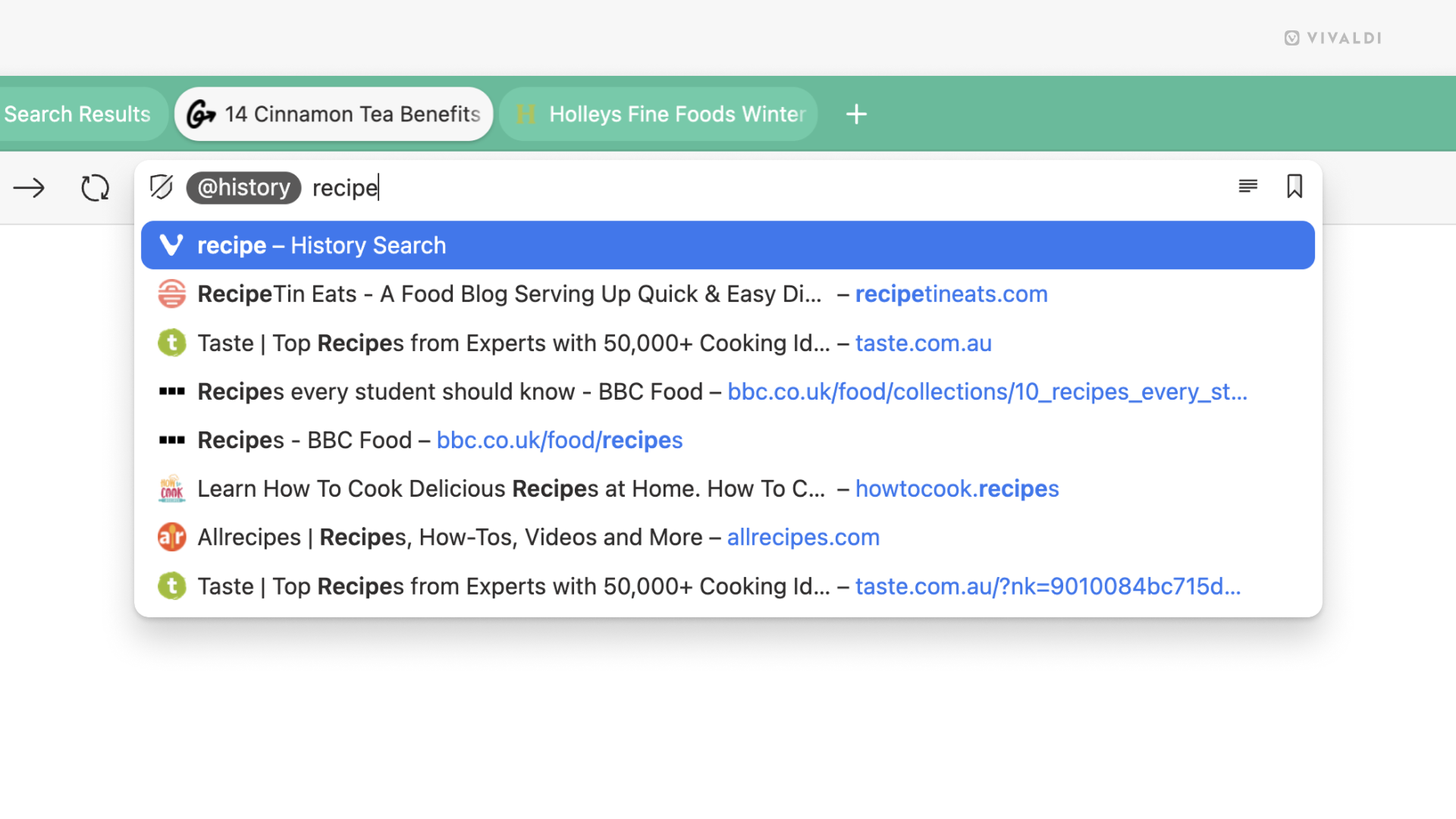
Desktop Tips
Tip #781
January 8, 2026
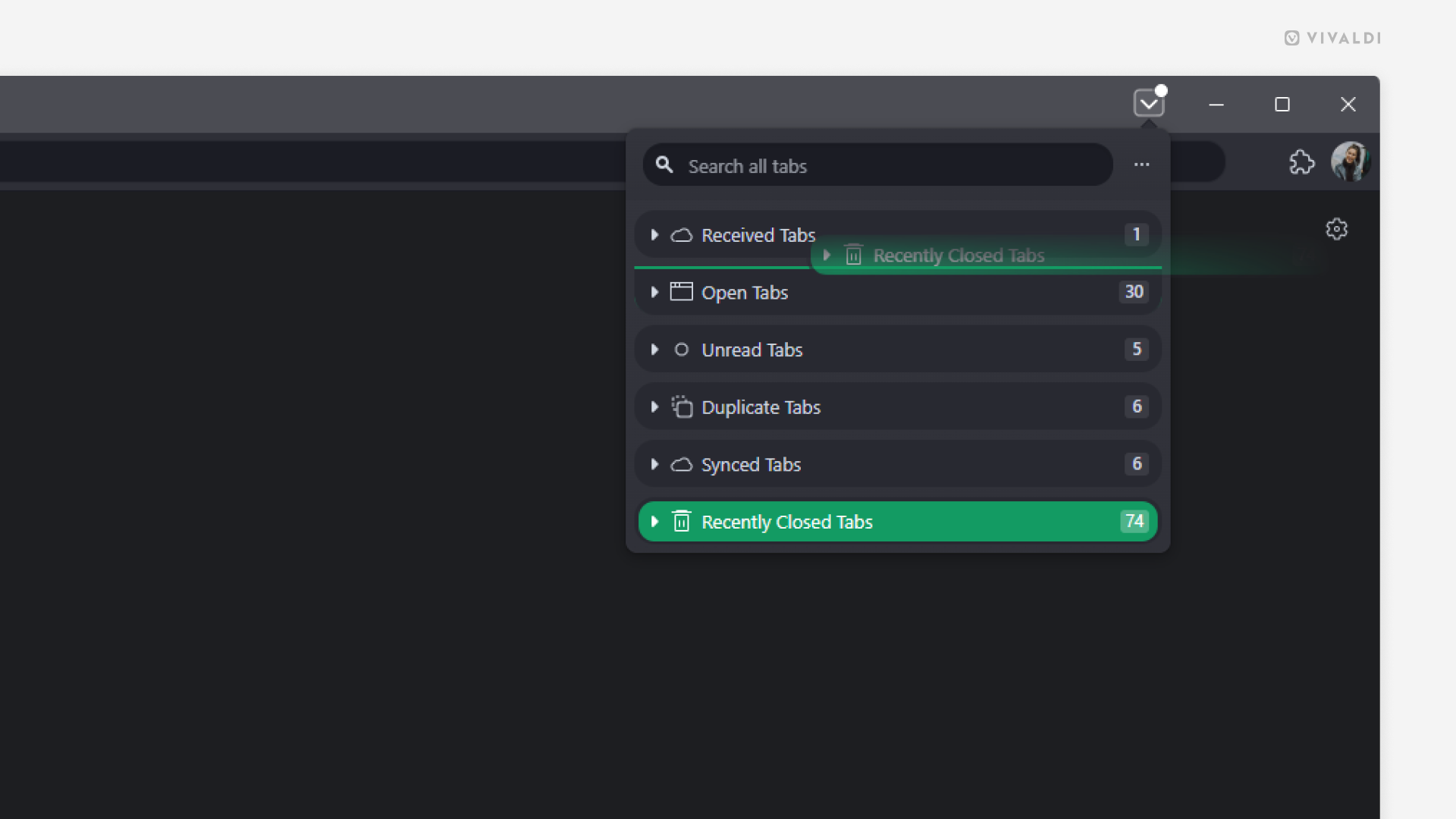
Reorder Tab Button sections to find the right tab faster.
Need quick access to synced or recently closed tabs rather than open tabs? Update the order of sections in the Tab Button popup to match your preferences.
To reorder sections:
- Open the pop-up menu.
- Click and drag the section you want to move.
- Release the mouse button to drop the section at its new location.
Tip #780
January 6, 2026
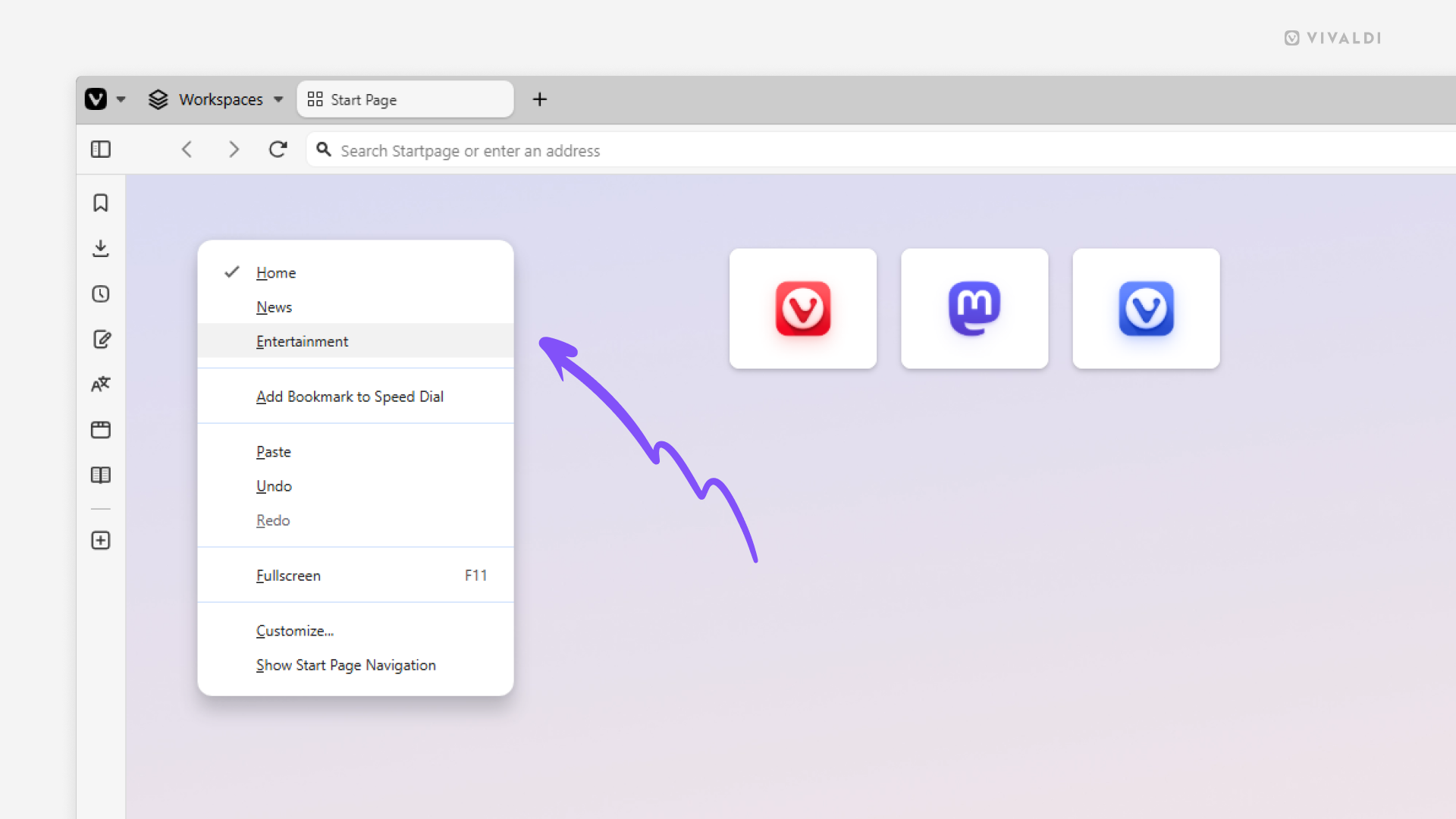
Switch Speed Dials from the right-click menu.
Have you hidden the navigation bar on the Start Page for a more minimalistic look, but still want to access your various Speed Dial groups? Luckily, Vivaldi offers you an alternative navigation option.
To switch Speed Dial groups:
- Right-click on an empty area on the Start Page.
- Click on the Speed Dial group’s name you want to switch to.
Tip #778
December 16, 2025
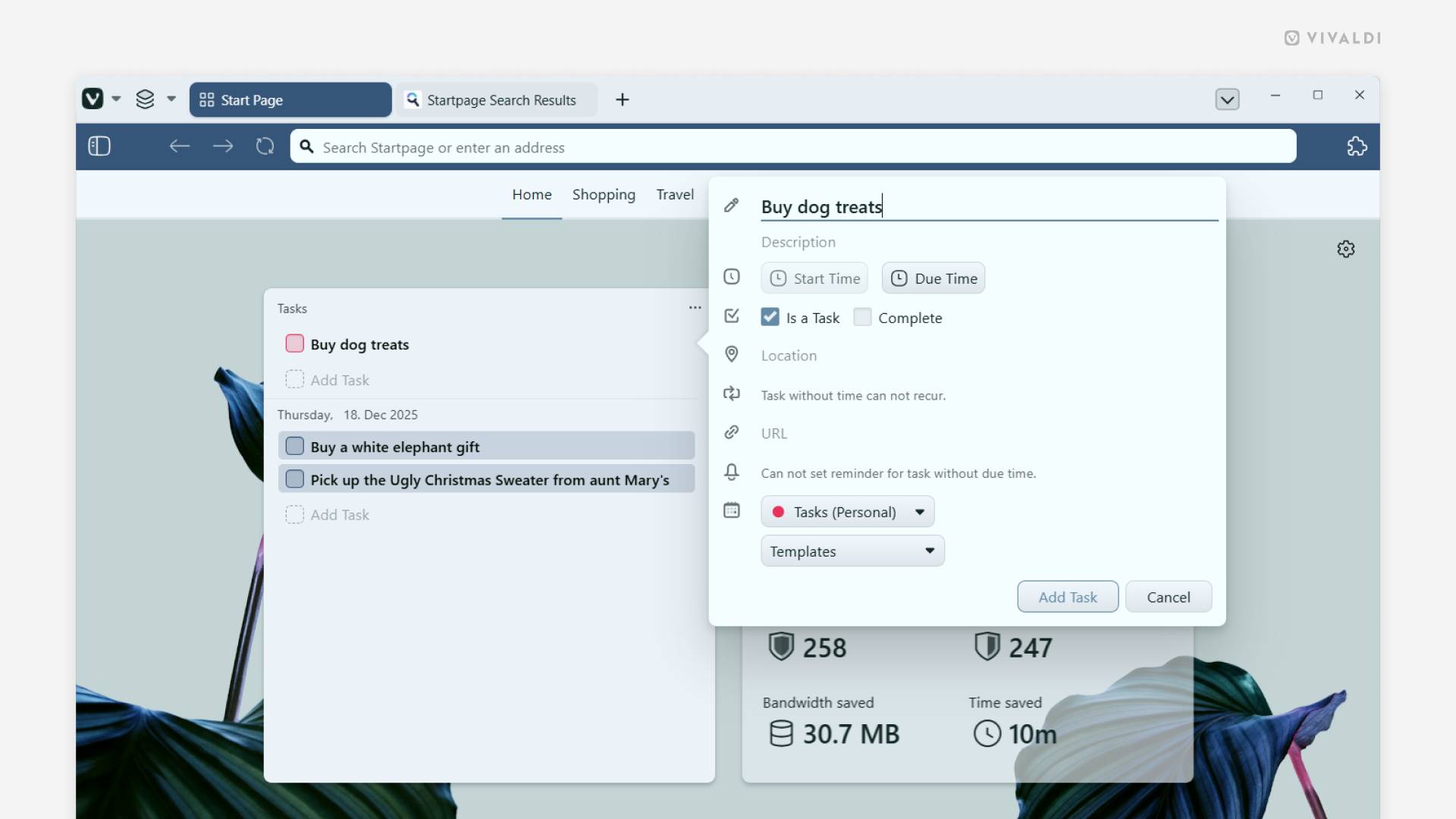
View and add tasks in the Tasks widget on the Start Page.
There are several ways you can view and add tasks to your calendar in Vivaldi. In this tip, we’re going to look at a way to do it on the Start Page.
First, to add a Tasks widget:
- Click on the “Widget” button at the bottom of the Start Page.
- Select “Tasks”.
To add a new task:
- Click on “Add Task” in the widget.
- Give the task a title, and, if needed, add a deadline and additional information.
- Click “Add Task”.
To mark tasks as done via the Tasks widget, simply click on the checkbox in front of the task’s title.
Tip #776
December 9, 2025
Discover all the ways you can move tabs to other windows.
We’re strong believers of the browser needing to adapt to you, not the other way around. That’s why in Vivaldi, the same action can often be executed in many different ways, so you could choose the one that works best for you.
Here are all the ways you can move a tab to a new window:
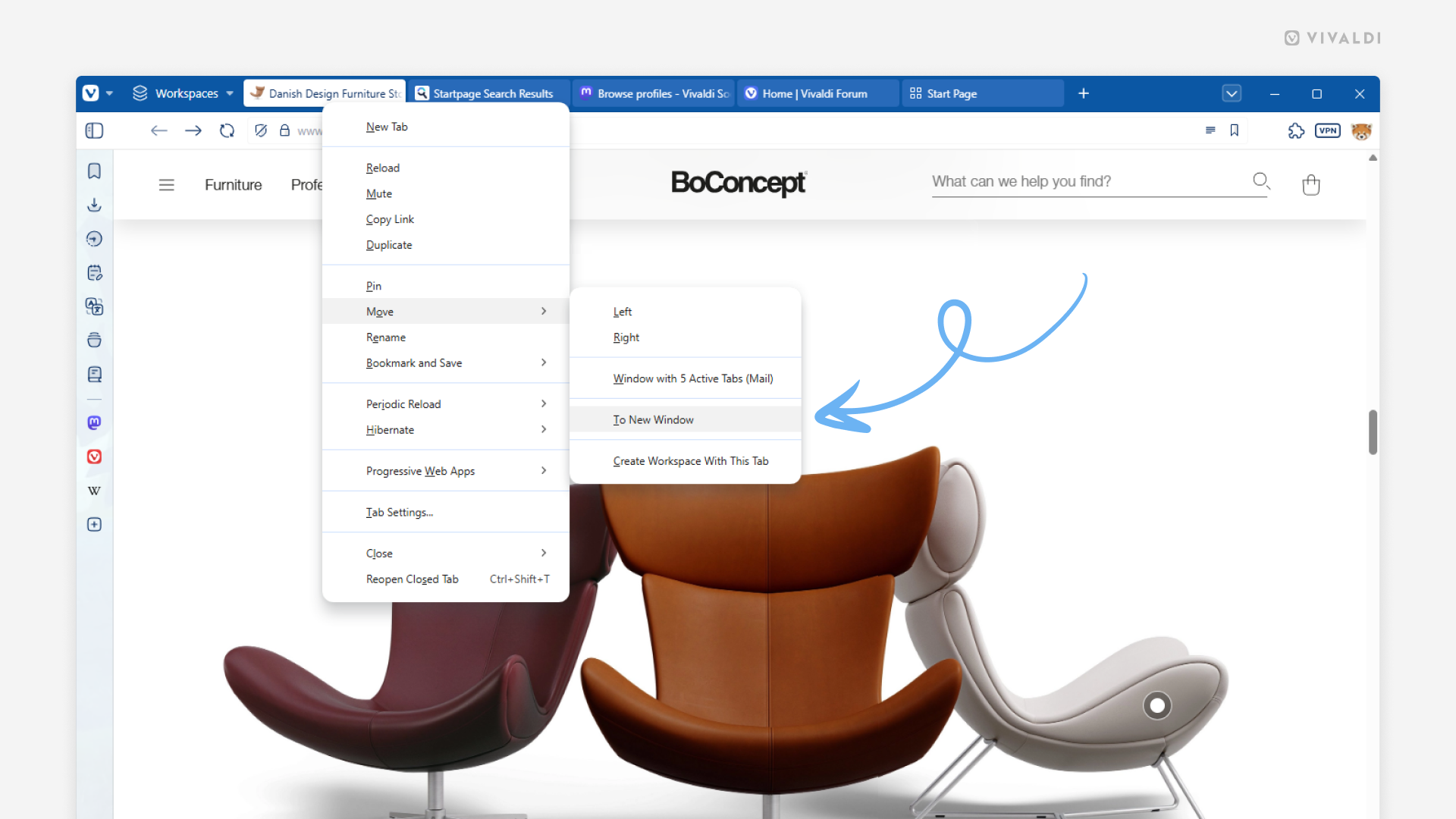
- Right-click on the tab on the Tab Bar and select Move > To New Window.
- Drag the tab off the Tab Bar, either outside the window or onto the web page area.
- While the tab you want to move is the active tab, type “Move Tab to New Window” in Quick Commands.
- Create a Keyboard Shortcut or a Mouse Gesture for the action.
And here are all the ways you can move a tab to an existing window:
- Right-click on the tab on the Tab Bar and select Move > Window with # Active Tabs.
- While two windows are side by side, drag the tab from one Tab Bar to the other.
- In the Windows and Tab Panel, drag the tab from one window section to the other.
Tip #775
December 4, 2025
Make your laptop’s battery last longer by enabling the Energy Saver.
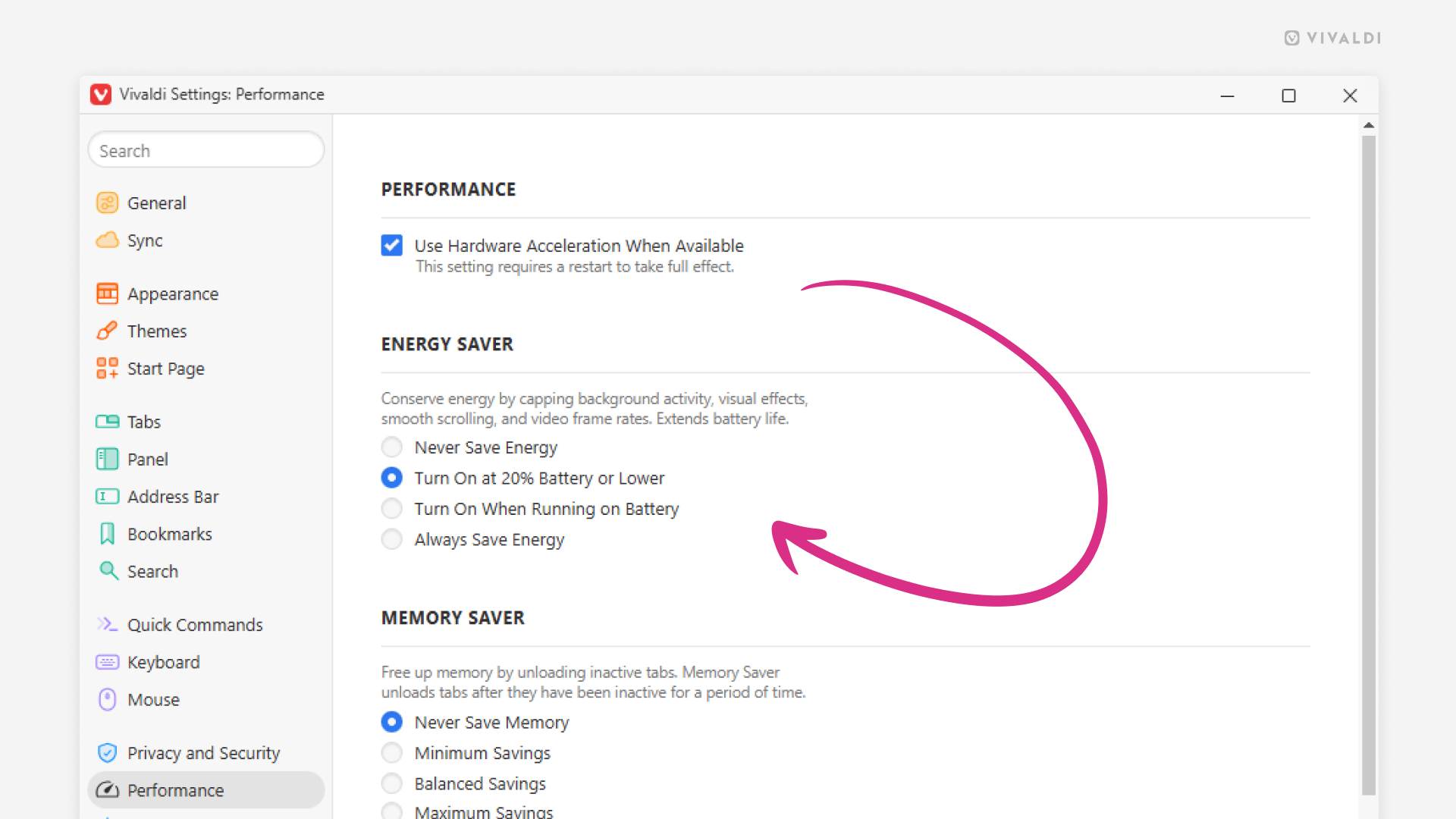
If you’re using Vivaldi on a device that runs on battery, you can extend the battery life by capping background activity, visual effects, smooth scrolling, and video frame rates.
To choose your energy saving level:
- Go to Settings > Performance > Energy Saver.
- Select between:
- Never Save Energy,
- Turn on at 20% Battery or Lower,
- Turn on When Running on Battery,
- Always Save Energy.
Tip #773
November 27, 2025
Open a group of synced tabs easily from the Windows Panel or the Tab Button.
When you’re browsing on multiple devices, you may find yourself in a situation where, while using Vivaldi on your computer, you need to access tabs that you have open on other devices.
To open synced tabs:
- Make sure you’re logged in to Sync with the same Vivaldi account on all devices, and that tab syncing is enabled.
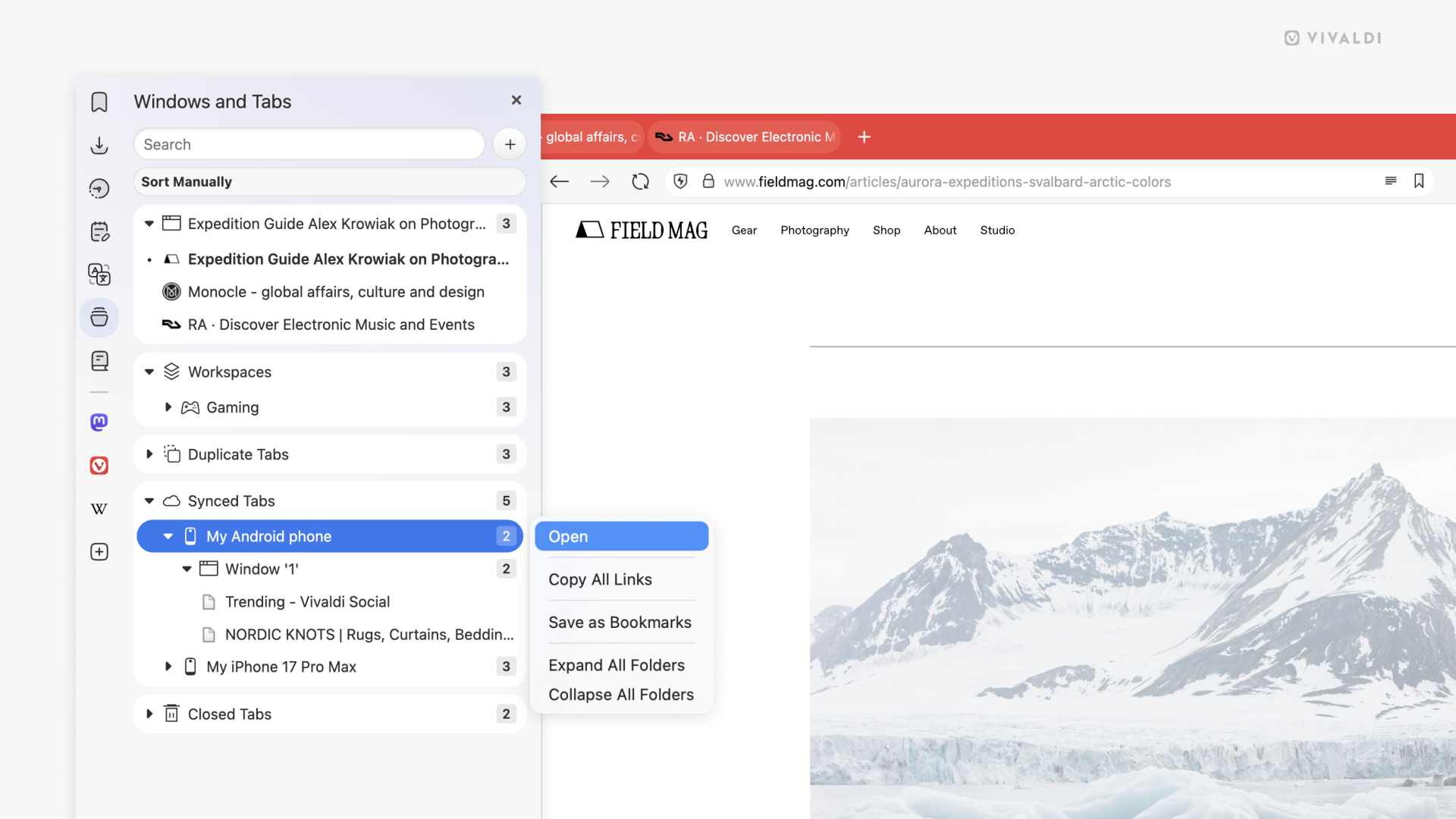
- Open the Windows Panel or the Tab Button.
- Right-click on the group of tabs you want to open. It can be all tabs on the device, in a chosen window, Workspace, Tab Stack, or a precise selection of tabs.
- Select “Open” from the context menu.
In case you only want to open one tab, a quick (double-)click on that tab in the list of tabs is all you need to do.
Tip #770
November 18, 2025
Check for updates on the browser’s About Page.
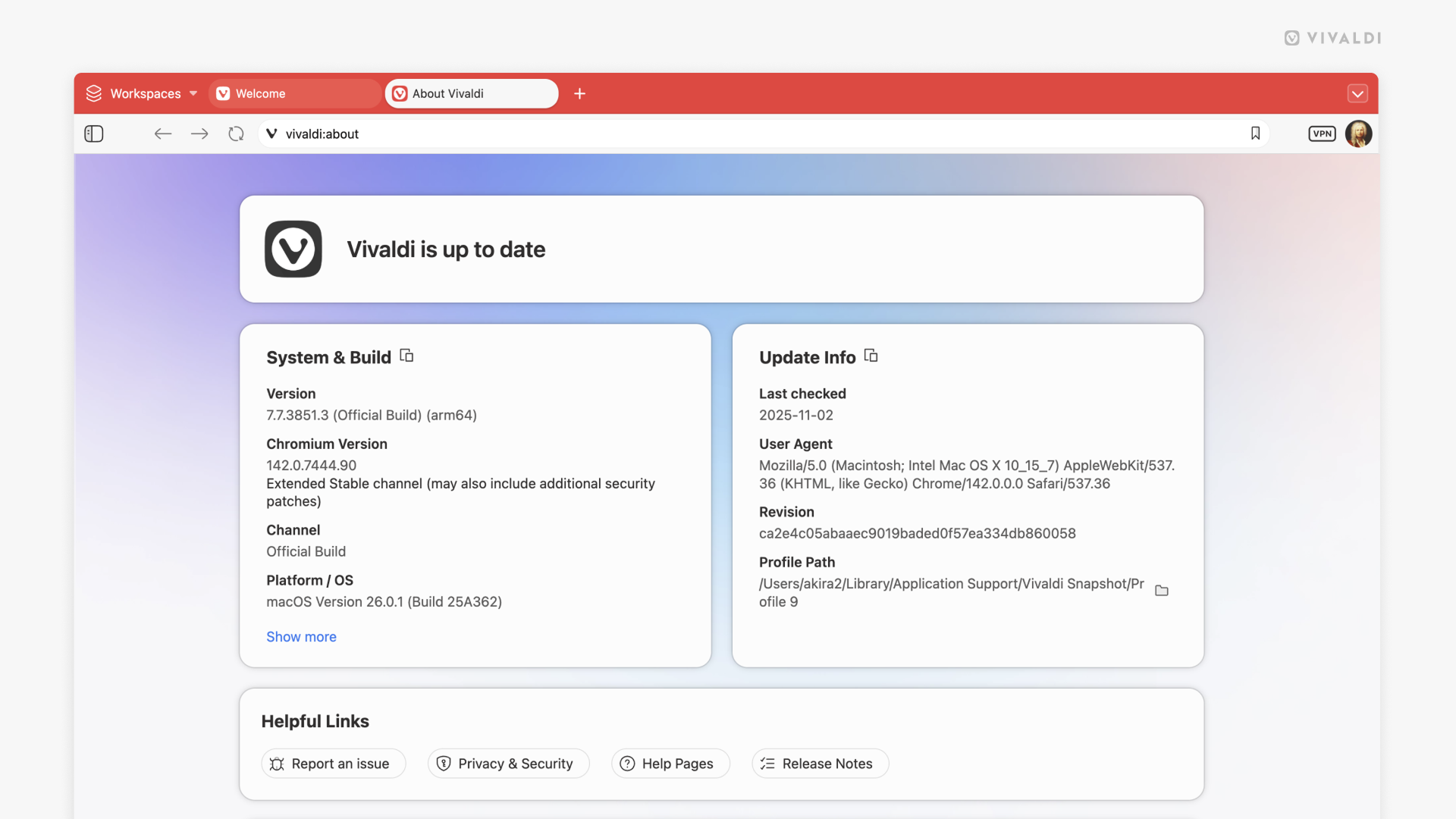
If you’re ever wondering whether you have the latest browser version with all the coolest new features and the most recent bug fixes, simply head over to the About Page.
To open the About Page, either:
- Go to the main menu > Help > About.
- Type “vivaldi:about” in the Address Field.
- Type “About” in Quick Commands.
There, on top of the page, you can see whether the browser is up to date, needs a quick restart to update, or, in case you have automatic updates disabled, an update can be downloaded.
Tip #769
November 13, 2025
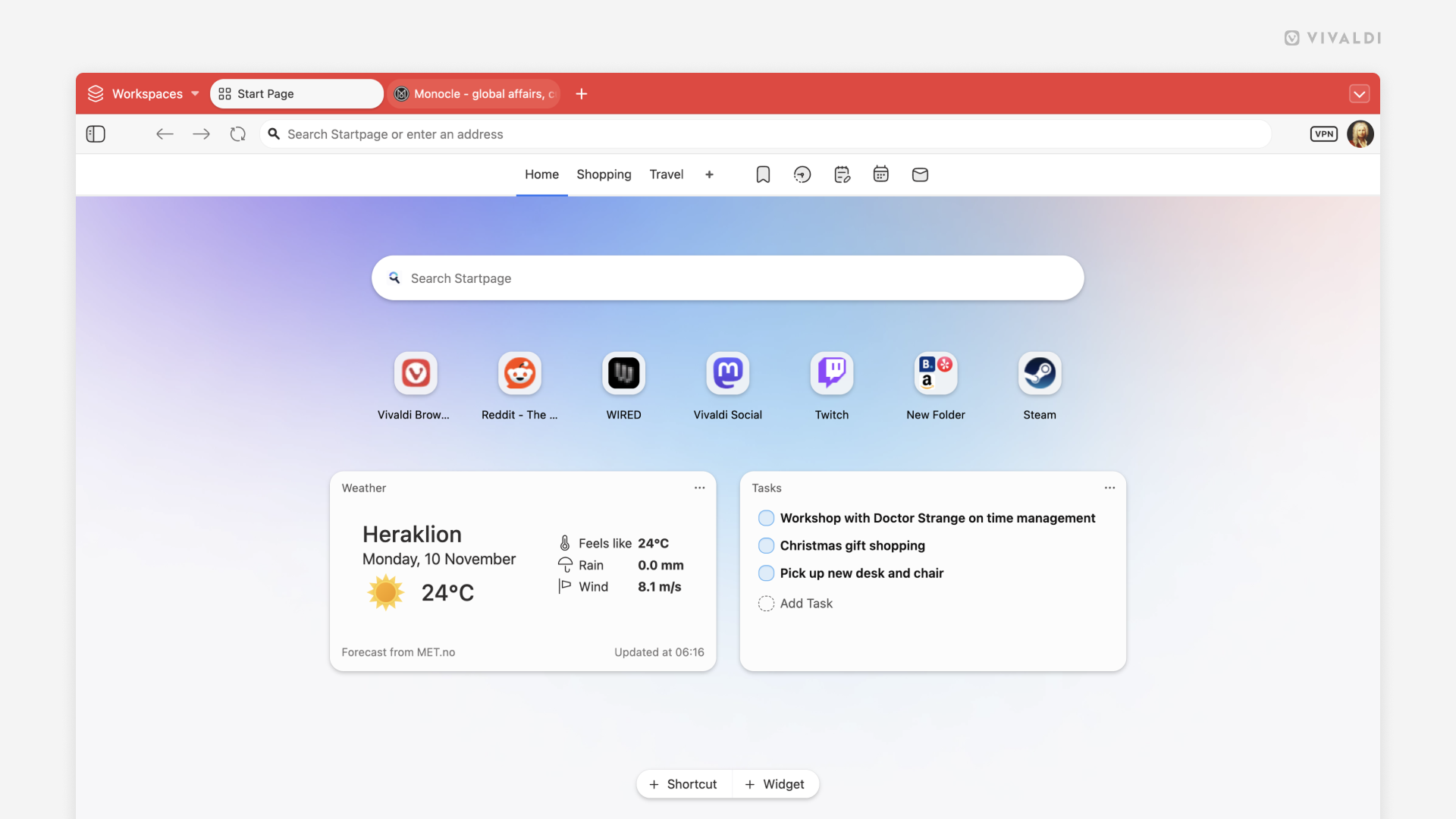
Make the most of Speed Dials and Widgets by combining them on your Start Page.
The Start Page is for populating it with your favorite and most used bookmarks – Speed Dials. To take it to the next level, you can also add Widgets to each Speed Dial group, creating unique dashboards that meet your browsing needs.
To add a new Speed Dial group:
- Go to the Bookmark Panel or Bookmarks Manager.
- Right-click on a folder and select “Use as Speed Dial”.
To add Widgets to the Speed Dial:
- Go to the Speed Dial group you want to add widgets to.
- Click on “Widget” at the bottom of the page.
- Click on the one you want to add.
- Repeat to add all the widgets you need.
Tip #767
November 6, 2025
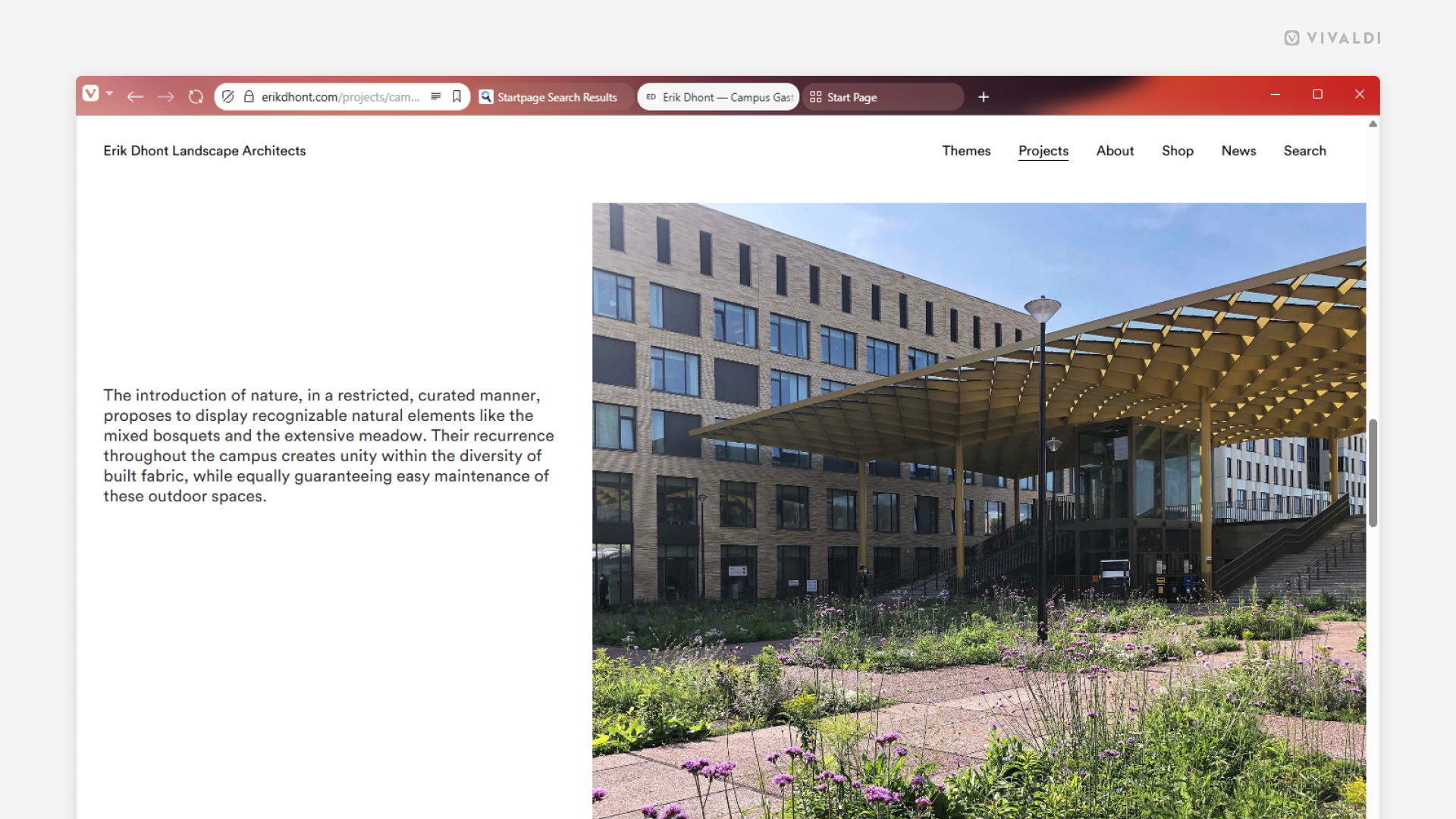
Gain screen real estate by merging Address and Tab Bars.
Whether you’re working on a small laptop screen where every pixel counts or just prefer a more compact look, Vivaldi’s toolbar customisation settings are here to help you achieve a configuration that works for you.
To combine the Address Bar and the Tab Bars, you need to move components from the Address Bar to the Tab Bar. Here’s how!
- Open the Toolbar Editor from the main menu > View > Customize Toolbar, or right-click on a component on the toolbars and select Customize Toolbar.
- While the icons are wiggling in their place, drag components you regularly use from the Address Bar to the Tab Bar (or to other toolbars).
- When you see a line in your theme’s highlight color appear, drop the component to its new place.
- When you’re happy with the result, click “Done” in the editor window.
- Then, in the main menu > View, click on “Show Address bar” to hide the Address Bar.
Tip#765
October 30, 2025
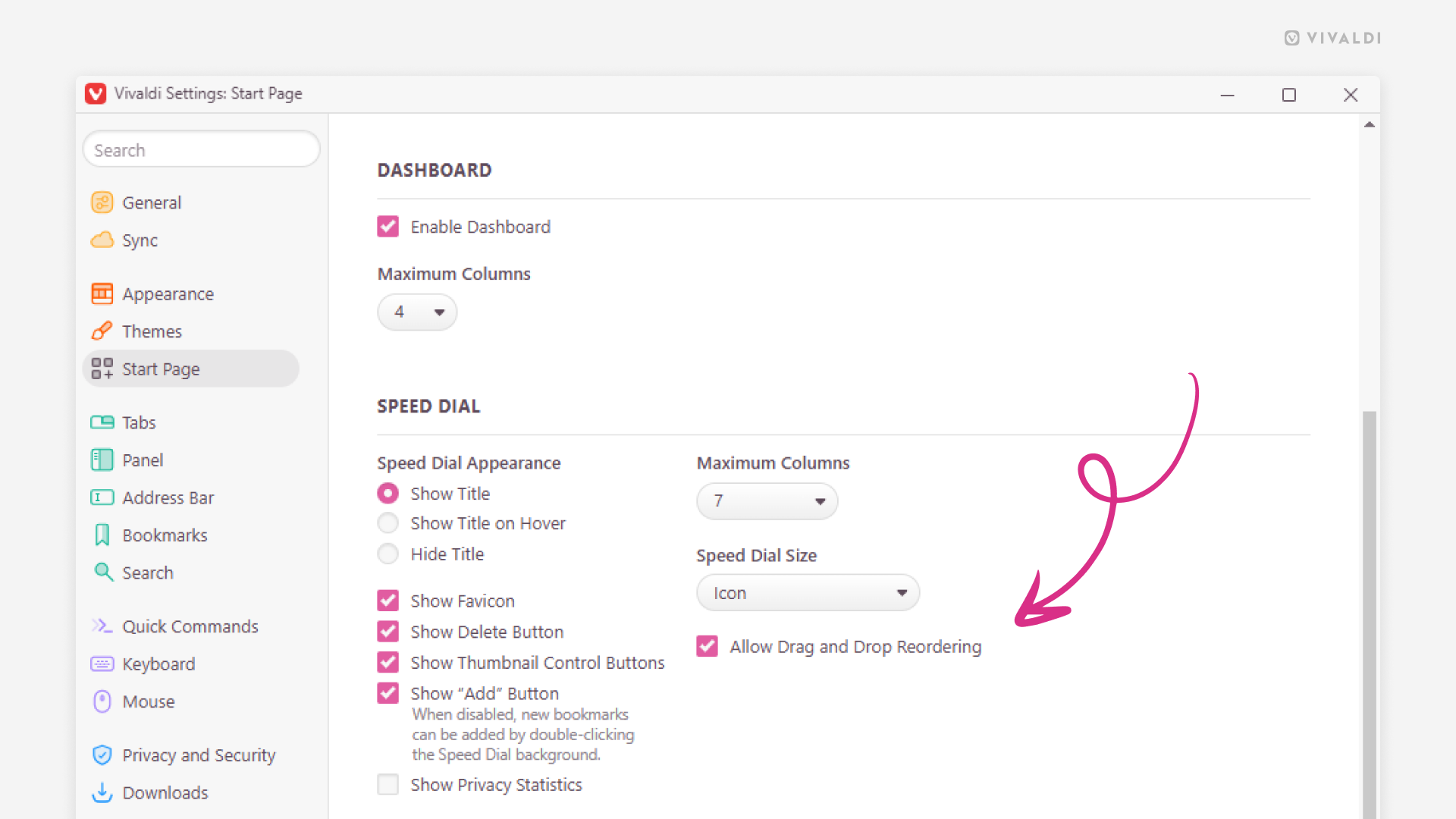
Prevent accidental Speed Dial changes by disabling drag and drop.
After having spent time on making your Start Page perfect by rearranging and customizing your Speed Dials, it would be a shame if things got disarranged because you accidentally clicked and dragged a Speed Dial. Luckily, there’s a setting to prevent it from happening.
To disable drag and drop:
- Go to Settings > Start Page > Speed Dial.
- Disable “Allow Drag and Drop Reordering”.
Tip #763
October 23, 2025
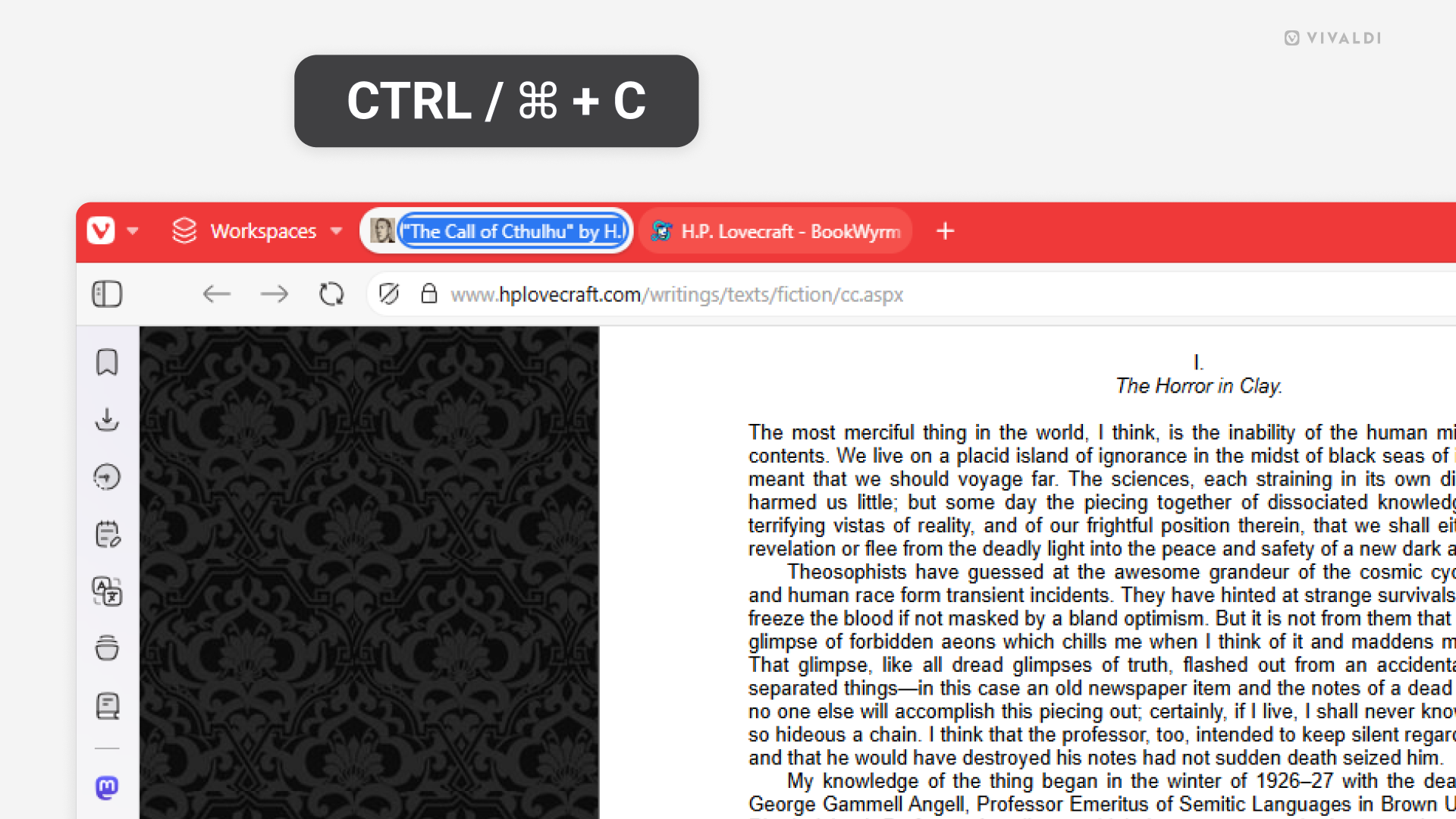
Copy web page titles from the Tab Bar.
Whether for sharing, document naming, issue reporting or something else. Sometimes it’s good to get the full web page title, especially if it’s not displayed on the page itself.
To copy the web page title in Vivaldi:
- Double-click on the tab or right-click on the tab and select “Rename” from the menu.
- While the title is selected, press
CTRL / ⌘ + Con your keyboard.
Tip #761
October 16, 2025
Search tabs, bookmarks and history using Shortcuts Nicknames in the Address Field.
In addition to searching for web content with a search engine, you can use the Address Field to search for Bookmarks, open Tabs, and History.
To filter searches in the Address Field:
- Type the nickname “bookmarks“, “@tabs“, or “@history” followed by a space in the Address Field.
- Then start typing the web page’s title or URL to see relevant results.
- Click on the suggestion to go to the web page.
Prefer using Quick Commands? See how to filter searches there in Tip #323.