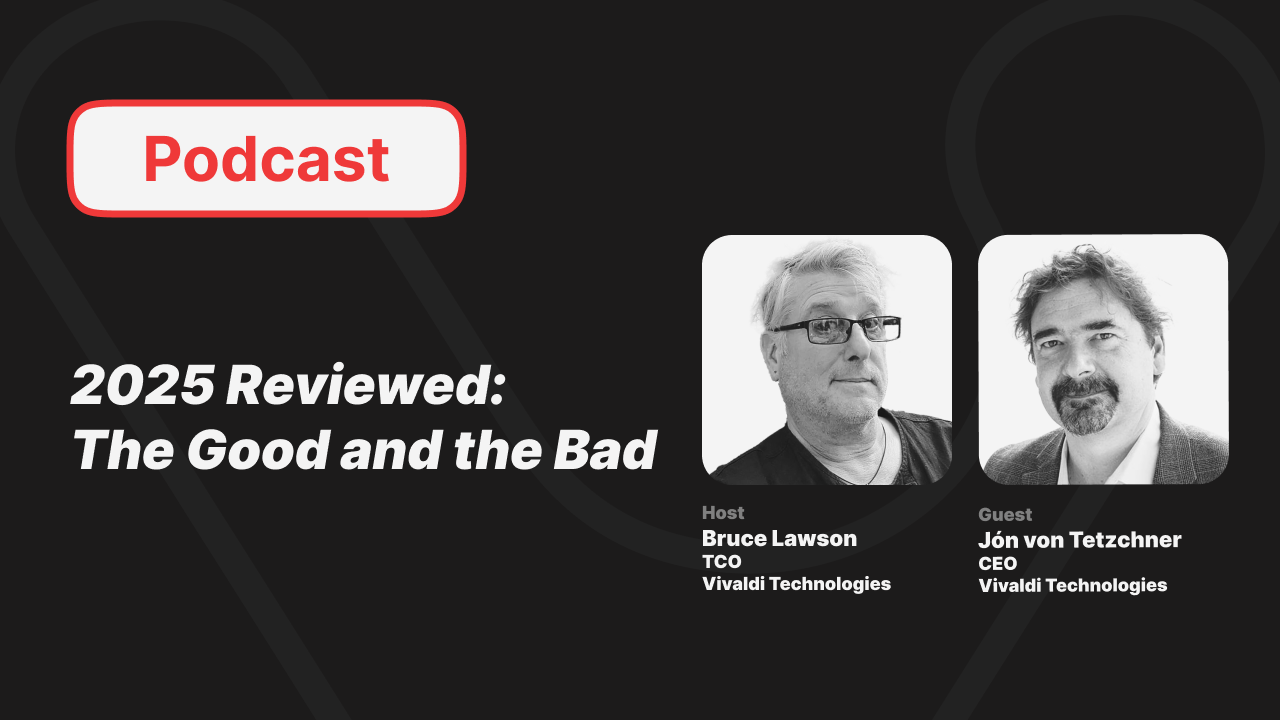
In this podcast series, Bruce interviews people from across different communities and industries who, in their own way, are fighting for a better web.
Vivaldi CEO Jón and Bruce reflect on the year in tech – what happened with browser choice, Big Tech’s grip on the market, AI everywhere, and why they think independent browsers matter. They also share their favorite Vivaldi features and why browsers should work for you, not the other way around.
Transcript
Bruce: So, everybody, welcome to a festive edition of the For a Better Web podcast. We’re recording this on the 18th of December, so 2025 is drawing to a close. And as is traditional at this time of year, we gather three wise men from the East. Unfortunately, there’s only two of us and I’m not wise and Jon is not from the east of me. But nevertheless, the one wise man from the Wild West, Jon von Tetzchner, CEO of Vivaldi. Hello, sir. Hi. How’s your year been? Fun?
Jon: Yeah, I mean, overall, I guess on the personal level, this has been a good year. I mean, if you look at the world, we can always have a discussion. There’s a wider discussion overall where the world is going. But on the personal level, it’s not been bad. Thank you.
Bruce: Good to hear it. Yeah, you mentioned the world. I’m not going to grill you on that. But given that the digital world and the real physical world are often very, very close to each other and one reflects the other. I don’t think we can get completely away from gloomier stuff. But before we do that, let’s talk about the happy stuff. 2025 was the 10th anniversary of Vivaldi Browser, I believe.
Jon: Yeah, I mean, that’s when we had our first, should we say, technical preview. We actually started working on the browser as far back as 2013. We can say that’s actually what the company founded. But we looked at kind of when we had our first releases, and that’s been more of the focus than when the company was founded. But, yeah, it’s been 10 years. Although, again, you know, my personal ties with the Internet goes further back. It feels like, well, most of my life has been dedicated to the web.
Bruce: So 10 years ago, when Vivaldi began, that’s about four years before I became a user. I was in reasonably early, but not at the beginning. What was it that you wanted to achieve when you set it up and then got people working on it and released it? And how far are you to getting towards that goal?
Jon: Yeah. I mean, it all obviously, I mean, we can’t really, when you ask that question, you can’t really ignore where we’re coming from. And obviously, the first company being Opera, my first browser company and having worked on the web for all those years. And after I left Opera, the idea was that I would not work on browsers anymore. But when Opera chose to go then in a different direction after I left, the feeling was, okay, no one is doing this kind of things that we would like to focus on. And basically putting the user first, not being shy of adding a lot of features, a lot of flexibility, adapting to the needs of every individual, seeing every person. The feeling was all the browsers were kind of heading in a direction where they were removing features, removing functionality, not really putting the user first. And those are the kind of things that I think we should be doing. So it was, I mean, a lot of people were asking whether I could do something about where Opera was heading. And no, I couldn’t really do anything about that. I was no longer with the company and no one really cared what I would have to say. But I could start another browser company, and that’s the decision that we did with Vivaldi. The feeling that: “okay. We need to build a fantastic browser that adapts to the needs of every individual, that sees every individual from the perspective of their needs. And again, listening to their feedback, not monitoring what they’re doing, but rather just listening to what people would like to see in their browser”.
Bruce: Was it that that huge amount of features and massive potential for customization, were you just too early when it was in opera? Was the internet in too much of an infancy for people to really need all the options? Or what’s changed, do you think?
Jon: So overall, I believe that we should adopt, we at Vivaldi, We want to adapt to the needs of the individual. And we don’t think we all have the same requirements. There’s accessibility questions, but there’s also just preferences. And in my humble opinion, there isn’t necessarily the correct way to do things. There is basically you ask individuals and they’ll have different answers on how they’d like to do things. And I think in a way, this is a fundament of who we are and what we are, that we would like to adapt to the needs of everyone. And I think we then end up with a browser that is great for everyone. I mean, yes, you need to potentially learn some new tricks, which actually probably will make you more efficient and the like. But I think people value the fact that we don’t take them for granted, that we don’t think we know best always. And that’s why we provide all these options and why we provide a lot of functionality. because it’s not really a question of what I want or what you want. It’s a question of, okay, does any user want this feature almost like? I mean, we would like to be able to do that. Obviously, we have to make some choices depending on how many people are asking for a feature and kind of what most people do want. But we also want to look at the individuals and try to adopt and put in features that maybe a smaller group wants, but for them it’s just very, very important.
Bruce: And all the features come from, I mean, sometimes I know our developers just want something, so they go and develop it, but a great deal of the features come from users themselves, don’t they? They come via the forums or feature requests or messages we get on Vivaldi social, for example. Yeah. And what is your favorite feature, Jun?
Jon: I mean, to me, the favorite in many ways is the flexibility. I mean, I have certain things. I use a lot of the functionality myself, obviously. And I know what people, based on the feedback that we get from users, what is important to them. I know they love having the flexibility when it comes to the tabs. I mean, again, we’ve gone overboard on this. But it is because people want to organize their tabs in different ways. Some people don’t want to organize their tabs. That’s fine. But a lot of people, they put up workspaces, they put up tab stacks, and then, okay, do they want the tabs on the left side or the right side or top or bottom? Or do they want them hidden and only show up when you switch tabs? It’s all an individual thing. I mean, as me personally, I like using workspaces. I like using two-line tab stacks. I use a lot of them. I have hundreds of tabs open at any one time. And again, that’s my use. But other people will have different use cases. I use the keyboard quite a lot. Personally, I’m a big fan of the keyboard shortcuts. That’s something we did early days at Opera. We did single-key keyboard shortcuts, which you can enable. We don’t enable it by default because people hit keys and strange things happen. But once you learn how to use that, it’s really effective. And again, it’s also thought of as an accessibility function as well, which I think is good. We try to think about those kind of things as well.
Bruce: Moving on from our 10th anniversary, and I’m not going to ask you to speculate what Vivaldi will look like on the 20th anniversary. Let’s look at the wider developments of the year. Last Christmas, we spoke about the impending court case/ judgment on whether Chromium and Google should be required to part ways. They haven’t been required to part ways. I know that you kind of felt it would be good if they did. I felt on balance that it probably wasn’t so good if they did, simply because I didn’t trust anybody to be a better steward of Chromium. But now the dust has settled a bit. How do you feel about that particular court case and its outcome?
Jon: I think when it comes to those kind of things, I mean, and this is complicated, right? So you kind of, it’s the devil that you know in a way, right? So that’s the reality. And I think in a way, that is where you’re coming from. And I just think that regulation is important. Do I believe that basically cutting up these companies, whether it’s Google or Microsoft or the like, is always the right way? No, not necessarily. I just think that there needs to be regulation as to what these companies are able to do with regards to kind of prioritizing their own products over others, in particular because they are gatekeepers to users. And I always think that the users should have the right to choose whatever software they want to use. And I think that’s important. I mean, obviously, I think there should be very clear rules what kind of data you are allowed to collect as a company. I mean, I’ve basically said that, and I still believe that, user profiling should be banned. Basically, the concept of building profiles on end users. So this is part of that as well. But obviously for us, as a browser company, if we are not able to be available on a platform, then that’s terrible. And I mean, that’s been an issue. We are not always allowed to have our browser on the platform. And then the question is how easy it for the end user to download us and are we able to integrate with services on the platform as well as all the browsers? I mean, the way it would work if basically, I mean, normally you would think that a platform owner would like to see applications on their platform, that they would like to see those succeed on their platform. But obviously, if they’re competing themselves, then that may influence their opinions on this. So overall, yes, when it comes to the Google case, they were not divided up. I think that’s fine. I do hope that basically regulators keep an eye on these companies because I kind of feel that if they’re not being regulated, there’s no limit to what they’ll do. And this is what we’ve seen with all of the big guys. Basically, they kind of run amok. And I think, again, they need to be reminded that they need to work fairly with competitors and they need to respect their users’ choices.
Bruce: I mean, I completely agree with you. It’s not that I think these companies are inherently evil. You know, we have friends, you have friends, I’m sure, in Google and Microsoft and Firefox, who are pretty good, and Microsoft. They’re not evil people. I just think it’s sort of, it’s in the DNA of corporations to tend towards monopoly. It’s just, you know, they try to maximise their market share and the obvious end result of maximisation is monopoly. And I think the only way that you can stop them is regulation. But it’s happening, I think. What’s your feeling about the world of the last year in regulation land? We’ve seen only today iOS has been told in Japan that it has to allow third-party browsers and third-party app stores and payment providers. Obviously, that happened less than 24 hours ago, so we haven’t seen huge sweeping changes across Japan, but it’s another country that’s not EU.
Jon: When it comes to regulation, I mean, we’ve been working with this for a long time. I mean, in many ways, the start of the web started with regulation fairly quickly. Now, Tim Berners-Lee did a fantastic thing by basically making the web open and anyone can go and implement the standards. And I mean, the development there was fantastic. But you then had a situation where a company, Microsoft, felt that their company and their rule, they were at risk, right? And then they went out and it kind of started with a Netscape case. And I think what you have there, you have big tech. And in the old days, it was simple. It was kind of the evil empire. That’s Microsoft. And clearly, they didn’t see the web coming. And suddenly, they saw, hey, this is a problem for us. This is actually existential for us. We might be left behind. We have to do whatever we can to cut the air supply, their words, from this new company, Netscape. And basically, they managed to do that. They killed Netscape. And as a consequence, there was a court case. And there was interrogation of Bill Gates, where he lied, and all those things that those of us that have been doing this for so long remember. So it shows the importance of the regulation. Because again, there was a strong chains. The web was coming. And again, big tech saw that it was a threat to them. And that was, in this case, Microsoft. And they killed this company, Netscape. And I mean, so it was a successful thing for them to do, which is sadly one of the things that big tech has learned that actually breaking the rules pays. But this is also why it’s so important that they actually get regulated. And we did see the impact after the fact that basically the fact that regulators had an eye on Microsoft, even though they didn’t split them up or do anything else, just the fact that they kept an eye on them was important. So whenever there is a new regulation like this, whether it’s in Japan or whether it’s in the UK or the EU or the US, it’s important because it reminds those big guys that they need to think twice about some of the things that they do.
Bruce: However, of course, we know that over in the US, there is a push against regulation, not from everybody, by all means, but from the prominent members of the current administration. And inevitably, an economy the size of the US, the prevailing sentiment, does send winds across to us here in Europe. How do you see that playing out? Should Europe stand up to the US or should we acknowledge, we, Europe, acknowledge the way the wind’s blowing at the moment and go with it?
Jon: So over the years, I mean, I’ve dealt with regulators for so many years. And what we’ve seen is that the regulators across continents, they actually work together and they look at what the others are doing and what is working and what is not. And I think that’s actually been quite brilliant in many ways. And I think the regulators are stepping up because they see the importance of the Internet and the fact that it actually needs to be regulated, that these large companies need to be regulated. The fact that some of these companies see it in their interest to try to make this a national issue, that certainly some of these large companies, they are American and that they try to then make it a nationalistic issue. I wish they didn’t because I think it’s really unfortunate because this would be in the interest of everyone to regulate big tech, that big tech needs to be controlled because they’re going too far. And I think, obviously, ex-Twitter is a great example of that. I think the fact that certain companies are picking on countries, I mean, the fact that you have Elon Musk basically pushing to dismantle the European Union because they want to regulate him and his companies is absurd. And obviously, that we cannot accept. Obviously, Europeans should be able to choose whatever form of government that they want, and Elon Musk should have nothing to do with it. Obviously, if the EU and Europe were going into some weird, weird, weird, twisted direction, then that would be different. But I think we all know that’s not the case.
Bruce: We do. And in fairness, and in the interest of not getting outraged emails from American listeners, it’s not all American companies pushing for deregulation. I mean, Y Combinator wrote a letter to the administration saying that the European Digital Markets Act was a really good idea. And it was in American interests to embrace it and potentially even adopt some of it. So, you know, it’s a big tech thing rather than a US thing, in my opinion. It’s just a coincidence, perhaps, that most of the biggest tech companies are in the US. But, you know, ByteDance in China, for example. Of course, a lot of the regulation stuff, a lot of the browser / computer industries changed a lot because of the thing that’s on everybody’s lips. and we talked about it last year, AI, artificial intelligence, which is possibly a word or a two-word pair that is so broad it doesn’t mean anything. You and I have been very public about saying that Vivaldi is not going to integrate any generative LLM stuff and from the fallout of the statement from Mozilla yesterday that they’re going all-in with AI. We’re certainly seeing a fair number of AI sceptic users coming to us. But also there’s these AI browsers. I don’t think of these things really as browsers because they don’t want you to browse. They want you to stay in their embrace. But how much of a danger is that, do you think, to the whole ecosystem, particularly like ours, a smaller browser pitted against the huge might of these AI companies? Are you worried? Do you sleep badly because of it?
Jon: No, I think, I mean, our focus really is on what users want. And what we are finding is that when we asked our users, oh, do you want AI in the browser? The answer was ranging from ‘no’ to ‘hell no’ for 95% of the users. And really, I think if you look at, so a lot of our competitors are pushing AI into the browser. And the real question is why? If the users aren’t asking for it, what’s the point of it? And to me, this is more related to the data collection. There is a fight to get access to data. I mean, you see that the AI companies are buying access to Reddit or other sources to use for their machines. And so if someone is pushing something like this and the users don’t want it, so why are they pushing it so hard? And I think that’s a really good question to ask. And in our case, we’ve looked at it and we just, okay, do people want us to put focus on this? And the answer to that question is a very clear no. And I think we have a strong position. We are being different from the others. We’re taking a stand. And again, if people want to use AI, they can use AI. We just don’t integrate it. And we’re not trying to monitor what you’re doing and put that into some machine. That’s not who we are. And that’s kind of our focus.
Bruce: Yeah. I mean, I say that to lots of people. If you want to go to ChatGPT, type that URL into your address bar in Vivaldi and you will go there. We don’t tell you what you can look at, but neither are we trying to insult your intelligence by allowing or making a machine guide you by the hand like you’re a toddler around the web. We know our customers are grown-ups. 2026, then, what do you think we’ll be talking about in 12 months hence? Will it still be big tech and AI? Do you foresee any resolution to those problems in the next 12 months?
Jon: I think in a way, yes, I do think we’ll still be talking about it. And I think in a way, the trend that I’m seeing is that people are being disgusted with what big tech is doing. So they’re looking for alternatives. And I mean, whether that is switching to Linux or it’s switching your browser to Vivaldi, or if it’s utilizing all the services that are not made by big tech, I think that’s a welcome thing. And I think in a way, because it is always hard for people to try out new things. There’s a lot of convenience and kind of just using what you’re being fed. And I think now people have an extra reason to look for something else. And I believe that will only continue. I think if you look at companies in Europe and the like, I mean, we’ve seen this. A lot of them are not able to use anything but big tech. So if you as a user are working in a big company or even a small company, quite often you’re not allowed to choose the browser you want to use or all the software. I think there will be a change there that people will look for serious software and will want to provide options to big tech as an alternative to those users that would like to do that and maybe even fully move away from big tech. So I think I see a potential for a significant move in this direction in this year, because, again, people are finding that, OK, big tech is actually taking a stand against them. And that’s a big deal. And to be frank, I wasn’t really expecting them to go this far.
Bruce: We’re seeing members of the European Parliament write to the commission saying, why are we requiring our staff to use Microsoft Edge? And they actually said in the letter they could use Vivaldi. This is a Chromium-based browser. It’s compatible. It’s known technology. But it’s from Europe. And I think there could be a great service if large companies, large organizations, governments mandated that people try to use, trying to source technology locally, whether that be in country or within the EU, rather than just going to big tech. Certainly, I wish my government would listen to me, but they haven’t asked me what I think yet, hopefully next year. Do you think that we will get there in the end? Maybe not in 2026. but before you and I retire, Jon?
Jon: Yeah, I think there’s a significant just movement towards, okay, this has gone too far. The fact that, like you say, the European Union or others, that actually people working there can’t use our browser, I mean, that tells you that there is a significant issue. And I think more and more are realizing that, that, okay, this isn’t how it’s supposed to be. We shouldn’t be doing deals which dictate that the browser that is being used. Obviously, you should always be careful with what software you install on your computer. But when you look at it, our competitors are actually collecting data. They have functionality that I think is quite dangerous with regards to data collection. I mean, functions like the recall function that Microsoft has added to Windows is kind of crazy to me. So from the perspective, why shouldn’t they then use a serious small company, but still significant, in Vivaldi and allow people to use our software. I mean, it should be given, right?
Bruce: I think so. And not just because I work here. I was a Vivaldi user for much longer than I’ve been a Vivaldi employee. So this is not me being nice to my boss for a massive pay rise, viewers. So what extra, what exciting new things can we expect in Vivaldi in 2026? Are you able to say?
Jon: I mean, I always like to keep the cards close to my heart and to my chest. And the point really being is, if you look at it, we as a company, we have a history of being the innovator in the field. I’d like to be able to say that both at Opera and now at Vivaldi. We’ve been the ones, you see the others, they copy our features. And I would like to keep it that way, that they copy our features instead of learning about them up front. But also the reality is what we do over the year, it isn’t given. We don’t have kind of these plans that will say, okay, we’ll do exactly this and that. We have a number of ideas that we’d like to focus on. Obviously, adapting to users’ needs on different devices and the like, I think is, I mean, that’s clearly the direction we are going. We have been adding support for cars as an example. So we’ll continue to go in this direction of adapting to the needs of the user. But I don’t necessarily want to go and say, hey, we’ll add this feature next month and then this feature. I want to surprise you all with some very, very, very cool stuff that we’re working on. So what I can promise, there will be a lot of useful things that we’ll be adding. And we’ve also said clearly it’s not AI.
Bruce: Well, on that note, I want to thank you, Jon, (a), for being here today and (b), for running a nice company that I enjoy working for and a growing company with a growing number of users. So that’s good. And thank you, listeners, viewers. Have a wonderful holiday season, whatever it is you celebrate or not, as the case may be. And a marvellous and prosperous 2026 to you all. See you after the holiday.
Jon: See you after the holiday.
Show notes
- Ten years of making new friends by building a browser for you, not Big Tech
- Apple Opens iOS to Developers in Japan
- Y Combinator urges the White House to support Europe’s Digital Markets Act
- Vivaldi takes a stand: keep browsing human by Jon
- “A.I.” browsers: the price of admission is too high by Bruce
- Parliament must buy European IT, lawmakers tell Metsola – A letter from MEPs to the parliament’s president name-checks European alternatives to buying Microsoft products