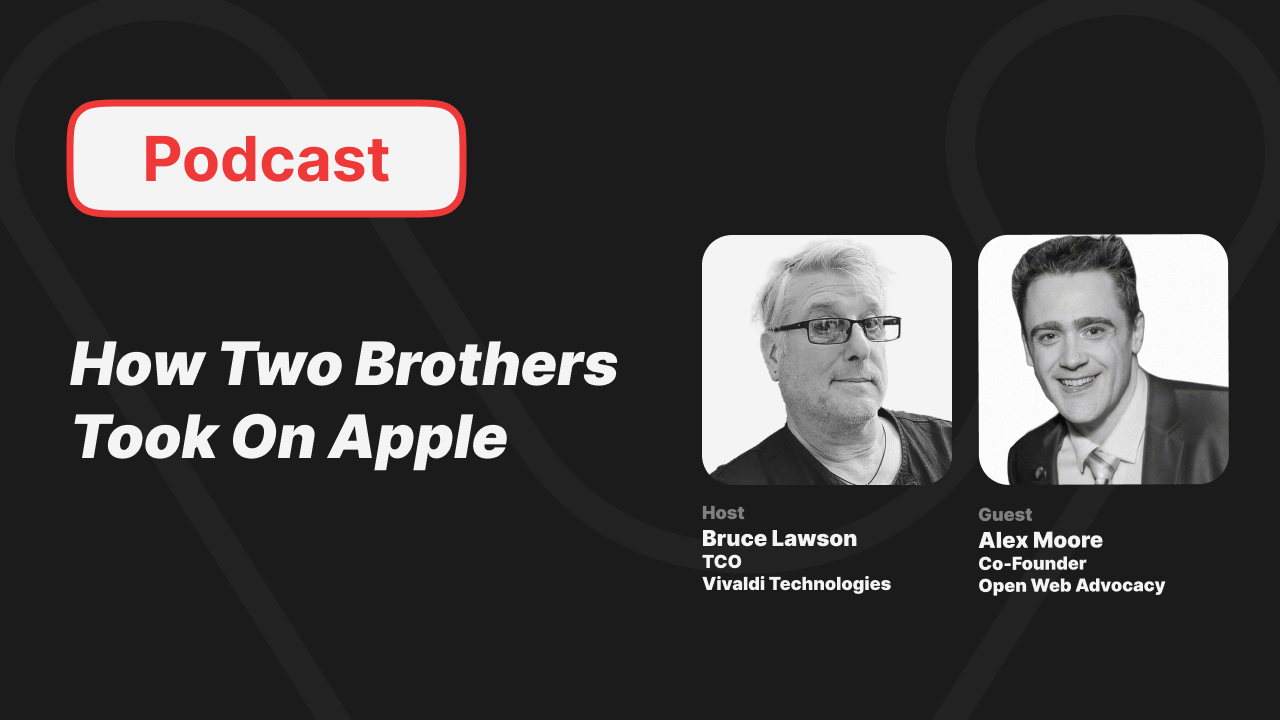
Bruce’s victim this time is Alex Moore, co-founder of Open Web Advocacy. We discuss why web apps still barely work on the iPhone, the rule that forces every browser on iOS to run on Apple’s engine and quietly limits what web apps can do, and the five year regulatory fight, spanning the UK, EU, Japan, the US and Australia, to change that. Alex also walks through the moment Apple tried to kill web apps across the EU entirely, and why he thinks Apple’s privacy and security arguments don’t hold up.
Transcript
[Bruce:] Hello, everybody, and welcome to another edition of the For a Better Web Podcast, in which I, Bruce Lawson, Technical Communications Officer at Vivaldi Browser, interview somebody who, in their own way, in their own industry sector, in their own neck of the woods, is working on making the web a better place. And today, it’s my pleasure to introduce all the way from Adelaide, Australia, Alex. Hello, Alex.
[Alex:] Hello, Bruce. Great to be here.
[Bruce:] How you doing, fella?
[Alex:] Yeah, not too bad.
[Bruce:] Brilliant. And Alex is one of the two brothers who started the group called Open Web Advocacy. And before we dive in, I shall say, full disclosure, I was a very early member of Open Web Advocacy. I was on the board when it became a non-profit. And I resigned–not because of any difference of opinion, but because I began working here at Vivaldi. And OWA was designed to be a group of independent jobbing web developers, which I was. And then I started working for a browser. So I’m not a member anymore, but we do send each other Christmas cards and Valentine’s cards.
[Alex:] So I like to think you’re doing the same job, except this time you’re getting paid.
[Bruce:] This time I’m getting paid. And whereas I’m not particularly money-oriented, this level of Botox doesn’t come cheap. As you probably know, Alex. So tell me, what is Open Web Advocacy and what is your fight?
[Alex:] So Open Web Advocacy is a non-profit, which is a fair competition for browsers, browser engines and web apps. Our primary goal is to get the web to be able to compete on mobile devices. I think if we look at the statistics now, the mobile web, even though on desktop, the web is extremely competitive. And by many stats is over 60% usage of all software on desktop. On mobile devices, it’s very small. Some quotes, even sub 13%. We think that’s down to a bunch of anti-competitive issues. Basically, we formed Open Web Advocacy to fight those issues and to try and bring the web back to mobile.
[Bruce:] Got it. And who is it? It’s you and your brother James, and who?
[Alex:] And a huge group of volunteers. So when we started, we started in 2021, March 2021. And very quickly, we had a group of about 10 that grew up to a group of 20. But along with a lot of just random engineers who volunteer their time on specific topics. And then about a year later, we actually formed the actual organization and created the discord. Now we’ve got a huge number of volunteers, people who work on the website, people who do, do regulatory documents, people who go to meetings, and they come from all over the world. So, fair to say that, James, my brother, brother and I, with the founders, but we’ve got a huge number of people who’s put a lot of time and effort over many, many years, including yourself, Bruce. And, yeah, I think it’s the only reason we’ve been successful today.
[Bruce:] And of course, there’s lots of people who are not formally aligned or members of, not there’s a membership. There’s just people who, read the calls to action from time to time and put their name to something or like like with the the PWA ban in well no the attempt by Apple to abolish progressive web apps in the EU. Do you want to tell us about that in without swearing or or actually committing act of violence?
[Alex:] Yes, so in response to the Digital Markets Act. the Digital Markets Act mandated that Apple open up to third-party browsers. And Apple realized that if they were going to allow real third-party browsers with the engines, they were also going to have to allow web apps be powered by those engines, and they did not want that to happen. We believe the reason they didn’t want that to happen is because then they would have a serious competitor with their $24 billion a year, app store revenue. They wanted to prevent that happening. So Apple’s creative solution was just to remove web apps from installable web apps from iOS altogether and basically just break web apps globally for everyone. And when I say globally, it’s because even though they were just going to revoke it in the EU, that would have such a chilling effect on the market that nobody would have ever built a web app again.
So for that month and a bit while while that was going on, we had a huge number of people working around the clock to try and turn it over. We had hundreds and hundreds of different companies, thousands of individuals, all coming together to try and build enough pressure to get out and reverse the ban. And so we did things like, we immediately informed the Digital Markets Act team. We launched surveys to demonstrate how detrimental it was going to be. And then we got thousands of responses in a few short days.
Then we wrote an open letter to Tim Cook. And we, as I like to call it, cc the Universe, all the way, from Tim Cook, down the entire power structure down to the individual web kit engineers, just to say, look, you’re going to destroy the mobile web by doing this. just please don’t do it. This is in real bad faith. And then eventually we got 4,000 individuals to sign, and 441 organizations with MEPs, many people from W3C, lots of various web standard celebrities signing it. And then Apple backed down and then they reversed course.
[Bruce:] So do we know actually what happened? Why they backed down? Because they just said something like, oh, we’ve heard you and we’ve decided not to and just wished it all away, didn’t they?
[Alex:] It’s a bit difficult to work out exactly what the pressure point was because we had about seven different things running in parallel. So some of them were media publications. It was, we worked out that it was likely illegal and that they were likely doing against the Digital Markets Act. but I assume it was a mixture between pressure and legal threat from the EU that really got it over the line. Plus just such bad publicity and, and just how many people were against it. And I’m assuming that even internally at Apple as well, people on the WebKit team would have been telling their, telling their superiors that, this is a bad idea.
[Bruce:] Yeah, because I was going to say that because you said that OWA and I was in OWA at that time. We see the WebKit engineers, many of whom I know personally, and those WebKit engineers have been adding PWA stuff into Safari, hadn’t they? There was the badging API and push notifications for Home Screen Apps, etc. So Apple’s obviously not one great big monolith, even though the man at the top is, as in any organization, the man at the top. Anyway, so I want to backtrack a bit, Alex, because whereas I’m interested, always in the fight and the results of the fight, I’m also interested in the people behind it. Why you? Why have you suddenly found yourself and your brother leading a global fight against a massive Goliath?
[Alex:] Yeah, I’d say purely by accident or would you say we just just draw the through the short straw. What happened was we ran a web development company and we were producing PWAs. And we’re doing a piece of point of sales software for a coffee chain. And the boss of the coffee chain was came to me and said, look, why are you making us buy all these really expensive Ethernet printers? They’re over a thousand dollars each. There’s these Bluetooth ones that I can buy for $70. And I was like, well, we could get it working on your Android tablets, but the problem is, is that iOS doesn’t support Web Bluetooth. which means we then have to create a native app, which means you’d have to be doing a native app distribution. That would slow down the ability to push updates. And then, so kind of sort of nodded and accepted, accepted that.
And then a few months later, it’s like, can we get every time a stock order is going to come in, can we get a notification to pop up on the screen? And I was like, again, I can do it for your, can do it for your Android devices. I can’t do it for the iPhone because they don’t support push notifications. And then my customer said, “why can’t I just download a different browser and we install using that?” Because all browsers on iOS was essentially the same, because Apple has a rule, which is 2.5.6, all browsers on iOS must use the WebKit browser engine – which basically means you have to use an Apple supplied web view, which is basically the entire viewable browser bit of the browser. And you can’t customize it or modify it in any way, and you certainly can’t add low-level features like notifications or Bluetooth. And so I said that browsers are essentially identical on iOS, except for a bunch of user-facing features. so it just won’t work.
And at that point, I thought, okay, that’s a good point. We’ve been waiting for notifications now, literally since 2000, and I think it’s 10 or 11 or whenever they came out for native apps. And certainly by 2015, they’d come out in Chromium, and I think the standardized version came out in Chromium, and then the following year they came out in Gecko. And then we, we, We tweeted at the WebKit team, said, hey, can we get notifications? No response. And I was thinking, oh, who would actually develop it and tweeted at the? No response. But they were responding to all these other people. And we just got radio silence.
So we decided to post on WWDC. And we were the most upvoted comment. It was basically, you’re five to ten years behind all the other browsers. The software’s full of bugs. We can’t build applications. We’re missing all of these critical features. Safari needs to double its budget. And we need other browser engines. So there’s competition to allow for browsers to compete and for the features to turn up. And we got some pro forma response, but that didn’t work. So we jumped into the Apple’s developer WebKit Slack channel and we’re like same sort of thing. Hi, this is, WebKit’s very, very behind. You need to get a lot more investment. And, web apps just don’t work in Safari.
And yeah, we’ve got some sort of very dismissive, angry comments back and then it was that point we realized it was a waste of time petitioning apple and that the only thing that we could really do is go after regulators so we formed a group on Twitter and we uh and we like right which regulators we’re going to talk to and we thought it was going to be simple. I thought, write a few emails, tell the regulator, they take it over and then the problem will be fixed.
And one of the first ones that came up was the UK’s CMA report. And I thought, it’s going to be a bit weird if it’s just two Australians talking to, even though I am a UK citizen as well, I thought it’s going to be a bit weird if it was going to be talking to the UK regulator, but we didn’t have any UK people in our group. And so I put the call out and then one of the things was is that you’d already been commenting on our tweets and threads and following us and like, Bruce, would you consider coming to talk to the UK CMA with us, the UK regulator? And yeah, and that’s how we met and along with Stuart Langridge as well. And then the rest is history.
[Bruce:] So I was your British accented “beard”, I guess. I mean, same as you, I thought. This was 2021, and Stuart is a mate of mine. In real life, we go drinking together ordinarily, but we couldn’t because it was another lockdown. And we thought, yeah, we’ll talk to the CMA. This would be an interesting little couple of months project during lockdown. Here we are at five years. actually, yeah, June 2021. So it’s five years down the line. So I know I’ve talked to many people. How many different regulators and trade organizations do you think OWA has spoken to now?
[Alex:] Oh, it will be a lot. So I would say in probably the EC Digital Markets Act team, and the UK regulator, the CMA, would be the most by far. Because the CMA, for example, we went through three successive investigations and some of them we would have at 30 plus meetings each. EU we’ve been very heavily involved with even all the Digital Markets Act went into law in fact when we first talked to them browsers browser engines and web apps weren’t even in the digital market side. So that was, we’ve also talked to Japan, the headquarters for digital market competition, and the Japanese Free Trade Commission. Is it free trade? It’s a federal trade.
[Bruce:] Isn’t it the Fair Trade Commission, JFTC?
[Alex:] Fair Trade Commission, that’s it. We’ve also talked to the United States NTIA, which is another government agency, the Australian ACCC. And we’ve had a whole bunch of outreachers with other countries as well. But I’d say most major would be EU and UK, then followed by Australia would be the three biggest ones that we’re engaged with.
[Bruce:] Which is a big percentage of the iPhone owning nations, apart from China. But China is a different beast. So is it fair to say that OWA stands for only something Apple? Do you just hate Apple or do you hate us all equally? “Us” being browser vendors.
[Alex:] No, I think the thing is we only target anti-competitive behavior where we think it’s going to affect the web competing. So we don’t, as a group, we don’t really stand for browser vendors. We believe we stand for the web on behalf of consumers and businesses. But the reason we’ve gone after Apple so much is because we believe that Apple is single-handedly holding back the entire mobile web ecosystem in a way that no other company does. And I think it’s good to put into perspective that all the big tech companies are anti-competitive. They all do anti-competitive behavior. And they will…
[Bruce:] Mate, mate.
[Alex:] We have actually criticized all of the… All of the major browser vendors. So for example, with Google, they kept a whole bunch of stuff for Chrome. A whole bunch of APIs for Chrome. They’d only allow Chrome to install web apps properly. That’s that’s called WebAPK minting. They refused to give the hot seat, which is the position on the block, in the EU choice screen. And we fought that very hard because we thought it’s ridiculous. I mean, we got the hot seat on iOS, but then Android isn’t going to deal with it.
Then over to Microsoft, with Microsoft Edge there’s been a whole bunch of dark patterns, where Edge tries to bully its way into being the default browser or stop other browsers from getting installed. And we’ve been very vocal about that as well. So I wouldn’t say we’re only focused on Apple, but it is fair to say that we’re, 80, 90% focused on Apple. But we will criticize all the other companies when we believe they’re doing behavior that’s going to affect the uptake of the web and the web platform.
[Bruce:] So I’m not trying to put words in your mouth, but would it be perhaps safe to say you criticize Apple more because Apple’s behavior is the worst, but it’s not specifically.
[Alex:] And unlike any other company. Like, we just have to, I think it’s really, I think it’s really, we need to explain to people. And I just quite often just how insane Apple’s policies are. The Apple’s policies aren’t a browser engine restriction or you have to use this component. Apple’s browser, Apple’s enacted. a browser ban in its entirety. The best way to think about this is if you think about each of the major browser engines and the people who work on them, they’ve spent hundreds of thousands of hours of work developing those engines. And the products around the engines. And then what Apple’s come along as they said, it said, look, we’re not going to allow that product. You cannot bring that product to our operating system. Instead, you have to then form a completely new team and build a completely separate product that is built around a component that we have sole control over. Yeah, okay, you can put some bells and whistles over the top. At the core functionality, we have dictatorial control over and you cannot modify.
And that just doesn’t happen on any other operating system. It doesn’t happen on Windows, it doesn’t happen on Mac OS. It’s insane, no other operating system does it, and Apple’s done it for 17 years. Now, I don’t know if you remember back in 2000, I think it was 10 or 11, Firefox was kicking up a big stink. But the problem at the time in 2011 is Safari was a fantastic browser. I would say Safari was the best mobile browser in existence in 2011.
[Bruce:] Well, that was before Vivaldi was formed. So yeah, fair enough.
[Alex:] Fair enough. But then Firefox was like, well, we want to bring our own engine. And that’s how I’m like, ah, as far as is, as far as good. Why do we need another browser engine? But then 10 years of underinvestment later, and then now the gap is so big, and there’s no competition. There’s no viable web apps on iOS. It’s just so you suddenly realize just how critical competition is.
[Bruce:] Okay, but devil’s advocate here. Apple iPhones are what, 10% of the world’s phones. 90% are Android. I mean, give or take, but the lion’s share of the phones in the world are Android. So why should anybody care what Apple does? Why was what Apple doing affecting the whole industry?
[Alex:] Yeah, I think one of the things is iPhone utilization is very different country by country. In fact, for example, like in Australia, I think iPhones are actually over 50% usage. Same in Japan. Japan is a very iPhone-heavy country. What you’ll find is the wealthier the country, the more iPhones there are. The other problem is the rich customers are almost overwhelmingly pushed towards iOS, and that also shows up in what their expenditure is, and what they’re willing to spend on products and software.
And then the thing is, the market that we need to look at is, although we’re really focused on consumers, the market we need to look at is businesses. The thing is, if you’re a software company and you’re developing a piece of software for a client, or even if you’re producing a software for your company, it’s very likely your boss is going to have an iPhone. And if not, he’s still going to want to target those customers first. And if you’re coming to your boss and you say, look, and you’re trying to come up with the pros and cons for building a web app, versus the pros and cons of building a native app, if you come to the conclusion that’s not going to work properly on an iPhone, then they’re going to go to it, they’re just going to build a native app. And then if they build a native app on iOS, it’s kind of like, well, Do we build a web app on Android?
When you think about it, the advantage of building a web app is that it’s identical on all operating systems. And you can iterate faster and you don’t have complex build processes and you can just push it up and you don’t have the 30% App Store fee. But if you remove the key advantage, which is the interoperability, then you’ve got one complex tool chain for iOS, then maybe you go, well, we’re really. we’re doing for iOS, maybe we’ll do native for Android as well. And so it just kills off the major benefit of web apps. And it’s, it’s kind of even worse than if Android didn’t support web apps, but iOS did. Maybe web apps would still be partially viable. But it’s really the interoperability that kills it off.
Now, I’ve talked to many business owners about this. I’m like, what would you need to actually decide I’ll be willing to get a web app instead of a native app? And it’s not the, it’s not being in the app store. It’s ease of installation and then reliability of the app after it’s installed. Because most web apps, most apps, the web supports the features they need. They don’t need this, the fancy very low-level graphic APIs that the native app ecosystems use. But at the moment, it’s not viable, because the discoverability is not there.
[Bruce:] Right. And of course, you can only be on the iPhone if you’re in the app store, which Apple take a percentage of. And they also charge developers, a developer license, and you have to have a Mac. And presumably, you’re not going to make an iPhone app, without owning an iPhone, et cetera.
[Alex:] I just have one point there. Also, you’ve got to think about how much this has changed the software industry. Before Apple came out of the iPhone, you just went to a website. You downloaded the software. You paid all of the money to the developer, and you got your piece of software. Now what’s happened is Apple said, look, we’re the only shop in town you have to buy from us. And if you start doing a thought experiment, what happens is, imagine I need to produce a piece of software, and I need to make $10 per user to return a profit on that piece of software. Then Apple comes along and basically they’re forcing a 30% markup of your product. Now, to get the same amount, out of money, you now need to charge $14. Mm-hmm. But the problem with $14.40, that’s going to push it up to another point on the demand curve, which means you’re going to have to sell more copies, which means you can have to raise the price even further to it, get some sort of equilibrium. And so it’s going to be at least $15. So you’ve got to think Apple’s basically imposed on consumers at least a 50% increase in costs.
And the thing is, they can, they’ll make arguments about, well, we built the app store. So, we deserve the money. We have to invest all these money in these APIs. But they have to do that absolutely regardless if you want to sell a phone. An iPhone without apps is useless. Nobody, if an iPhone just had Apple apps, nobody would buy them. It’s, and what it turns out is that the app store is one of the highest margin products in the entire world, which is indicative of a non-compestive market.
[Bruce:] Excuse me, you seem quite, quite cynical, Alex, because you’re implying that Apple do this for money. But they market very carefully on the fact that their ecosystem is about security, performance, and privacy. Is there, in your opinion, in OWA’s opinion, how valid is that argument? That by enforcing effectively a monopoly, they are more secure and speedier and protecting you better?
[Alex:] Yeah. So I would classify myself as a pretty heavy iPhone user. I mean, I’ve got hundreds of apps on my phone. If Apple had actually done that, like they’d actually had a store that was heavily curated, they got rid of all the spam apps and all the apps trying to gouge you of money. They might have an argument. But I think anyone who’s actually… actually use the app store, we’ll realize that’s just not the case at all. I mean, you just have to go on to Facebook and click on any ad that comes on your screen. And it will be, maybe it’s a game that will, will try, will be free, but then we’ll try to gouge you and then start doing loot boxes to try and try and extract as much money as possible out of you or be a gambling ad, or a scam app that pretends to scan your iPhone for malware. I mean, these are all apps that are in the app store that they just haven’t been able to get rid of.
The other thing is the iPhone’s not actually particularly private at all. And there’s a good reason for this because, and I like to compare the web to how the iPhone was developed. The web was developed over a really, really long period of time. The app store was “hi boys and girls, we need a really quick API, software development kit next year”. And it got built very quickly, and it wasn’t built with the same security and permission controls that the web was built with.
So then they rely on app review to patch those framework floors. But the problem is because of the volume of apps and you don’t have software engineers going through every line of code, app review ends up being essentially a bit useless because you have somebody just clicking for the user interface for two minutes and then deciding whether to pass it, or not, mostly based on Apple’s business rules. And there was a great quote that I’d love to read to you. It was from Apple’s head of fraud, Eric Friedman. And he said, “app review is like bringing a plastic butter knife to a gunfight.”
Investment will have to be made making that process more robust or they will keep getting rolled. Now, the thing is, that’s the app store, is that you’ve got all these APIs that you’ve got fairly free reign. A good example is I was secretly tracked by one app via Bluetooth for about 10 years. Or no, maybe seven years. And it wasn’t until Apple did an update. And it said, are you sure you want this app to have Bluetooth? And I was like, what? Why does that app have Bluetooth at all? It makes no sense. It’s for chatting. You don’t need Bluetooth for chatting. And then I looked for it. And then what they did is they installed Bluetooth at shops. And then as you walk around with the app, the app secretly talks to the beacon and it tracks you from store to store. And what Apple would have done is they’re just, allow Bluetooth on by default. And it was just, tracking me everywhere I went.
The thing when you start talking about the web, the web is a hostile environment. So you need to be, you, it’s a trust nothing by default. environment. So everything is gated by permissions. There’s really no easy sensitive access to sensitive functions or sensitive data. And at the top of it is you certainly don’t want when you go to bad website.com for it to jump and access your banking tab or any data in your banking tab. And that’s been built into the web so heavily over such a long period of time that it’s extremely robust.
The other thing with the native app ecosystem is there’s a really great app by Mysk. There’s a couple of great security researchers, called Loupe, and it’s a fascinating piece of software. You can install it on your iPhone, and it will tell you everything that a single app can see. When I tried it on my phone, it’s astonishing. It knows the names of all the other apps you’ve installed. So it can iterate through, it will know if you’ve got Facebook, it will know if you’ve got Tinder, if you’ve got signal. And the amount of data the apps have access to is just crazy.
And so I think Apple hiding behind privacy or security is just laughable. In fact, there was a good quote from Apple themselves where they said, the browser engine sandbox for Safari is orders of magnitude more secure than that for native apps. And they’ll use this excuse to block browsers and web apps and browser engines.
[Bruce:] That makes sense, I suppose, because the web’s always been treated as a hostile environment, whereas the App Store is sold on a “you can trust us” environment because “we are taking a 30% tax to protect you” is what Apple promises.
[Alex:] And the App Store has got worse. Like I would say the App Store in, early on, was significantly better than the App Store now. Just the quality of apps overall was higher. I think it’s gone especially after they built, brought in app purchases. It’s just something allowed for a lot more of the scammy behavior. And I think Apple’s very focused on App Store revenue growth. And they basically started relying on this false sense of trust through the App Store. promises.
And I think the biggest tool Apple has with App Store is the ability to revok the app from the app store. If it’s called something to something too naughty. And there has been some really bad ones, like, LastPass was a password management app, like 1Password. And there was another one that got put on the app store called LastPass with a 2 S instead of a T, and then that would steal credentials from real LastPass to loot users and use it to hack all of their all their accounts.
[Bruce:] There was apps that were pretending to be something else, but giving access to Russian banks, when Russian banks were sanctioned, as they still are. I’ve found that one to be quite extraordinary. So what does the day in the life of a dynamic, good-looking, global, global influencer look like? Presumably, it’s all glamour.
[Alex:] No, I wouldn’t consider myself an influencer. I’d say the majority of our work is spent convincing people that this is a worthy fight, and it’s worth spending effort and time on this, and that it will have a big outcome. And I think the problem that we have is a lot of, a lot of, just because of how the mobile ecosystems have developed, there is a huge focus on native apps. Because the web app, the web apps never got realized on mobile, it’s very hard to show people the future that they never got. And so one of our, one of our, the things that we work hard on is describing, look, there’s not much difference between a web app and a native app. I mean, all you got to do is occupy the screen, accept some touch inputs, and make sure you can paint to the screen 60 times a second, and the web app can do anything that a native app can do. And so we do a lot of very detailed responses to regulators.
We’re not experts at everything. So quite often, so I remember one time I needed to make some arguments about web Bluetooth and Web NFC. So first, I needed to go talk to a very top level expert. So he could explain to me how NFC and Bluetooth hardware actually worked so that I could understand the next layer up. So that by the time I spoke to the regulator, and I kind of knew what I was actually talking about. But with regulators, you really have to be You have to be like, what’s the problem? Why is it bad? How do you fix it? And if they fix it, how it be better? And be willing to go down to much as many details they want and answer questions from lawyers or technologists or economists about how that will affect the wider ecosystem. And so, main day-to-day work is talking to regulators and allies who want this change to happen.
[Bruce:] I remember when we met the CMA, that’s the UK competition regulator. TYou got in contact with me via an introduction from an Australian developer called John Allsopp, aka the Gandalf of the web. And at the time, the CMA were investigating the mobile ecosystem, but they were looking at basically the Play Store versus the App Store. And we sort of rocked up and went, there’s a third way. And it’s called the web. And they, I think they were so shocked that ramshackle developers in their lockdown bedrooms should turn up and talk to them. They actually listened. And thus it happened. So are we going to win?
[Alex:] Yeah, that’s a good question. I’ve got good hope that we’re going to win but it’s going to… I mean I never expected to take this long. I thought we’re going to win the first year, but I’m a bit more realistic about our outcomes we we have already won significant battles. For example, Safari’s budget has probably been doubled since we started our work. That’s fantastic because Safari having more features and functionality is great for everybody. promises.
There’s a lot of developers –I don’t know about yourself– but if it doesn’t work in Safari, it doesn’t work on iOS, maybe you can’t be bothered using that feature. And so quite often what we do as soon as a feature turned up in Safari would be really excited because we think, now we can actually use it. And so by just that budget expanding, there’s the capabilities of the the general web, maybe not specifically web apps, but general web features goes up and up.
The other thing is the we got push notifications, which was a big win. Then we’ve obviously got browsers and browser engines into the DMA, the Digital Markets Act. And you might remember, Bruce, I don’t remember back in 2021, it was exactly three weeks after our meeting with the CMA that push notifications started getting developed. And just for our audience here, what happened? We had, we had three presentations. It was my presentation, then Bruce’s and Stuart’s, and a key theme in each of the presentations was we couldn’t do something because we didn’t have push notifications. And then somewhere between there and three weeks later, Apple decided to start working on it.
[Bruce:] So we are making some change. My last question, Alex, because I’m conscious of your time; you’ve got a busy day of shouting at regulators ahead of you. When they make the movie of how OWA opened up the web, obviously, I will be played by probably George Clooney. Who will play you? And you’re not allowed to say Kylie Minogue.
[Alex:] Russell Crowe.
[Bruce:] Fair enough. You heard it here first. Alex, thank you very much for your time and you continued hard work with Open Web Advocacy. Thank you. Thank you. Thank you, dear listeners, for listening again. I will put notes for all the stuff we’ve discussed in the show notes. and also a link to OWA and how you can get involved in your country. You don’t have to sign up for a number of hours a week. Just when a call to action comes with your regulator, write a couple of letters or something like that. It’s the power of normal web developers that have pushed this forward. So we need you, basically. Alex Moore and James Moore, behind the camera, thank you for your service, gentlemen. And see you next time on For a Better Web. Ciao!
Shownotes
- Open Web Advocacy
- Alex Moore on LinkTin
- OWA’s open letter to Tim Cook about PWAs
- Apple rule 2.5.6 (the WebKit restriction)
- Bugs: An Abridged History of Safari Showstoppers
- Stuart Langridge
- Japanese “Smartphone Act” (PDF)
- Vivaldi’s Open Letter — Microsoft DMA Compliance
- OWA’s Response to SMS Investigation into Microsoft’sBusiness Software Ecosystem [PDF]
- WebAPK minting
- How Russian firms get their apps into App Store despite sanctions
- “a plastic butter knife to a gunfight”
- Loupe app
- Apple: Safari’s browser engine sandbox is ‘orders of magnitude more secure’ than that for native apps [PDF]
- Fraudulent app attempting to impersonate LastPass app on the Apple App Store
- Russell Crowe