
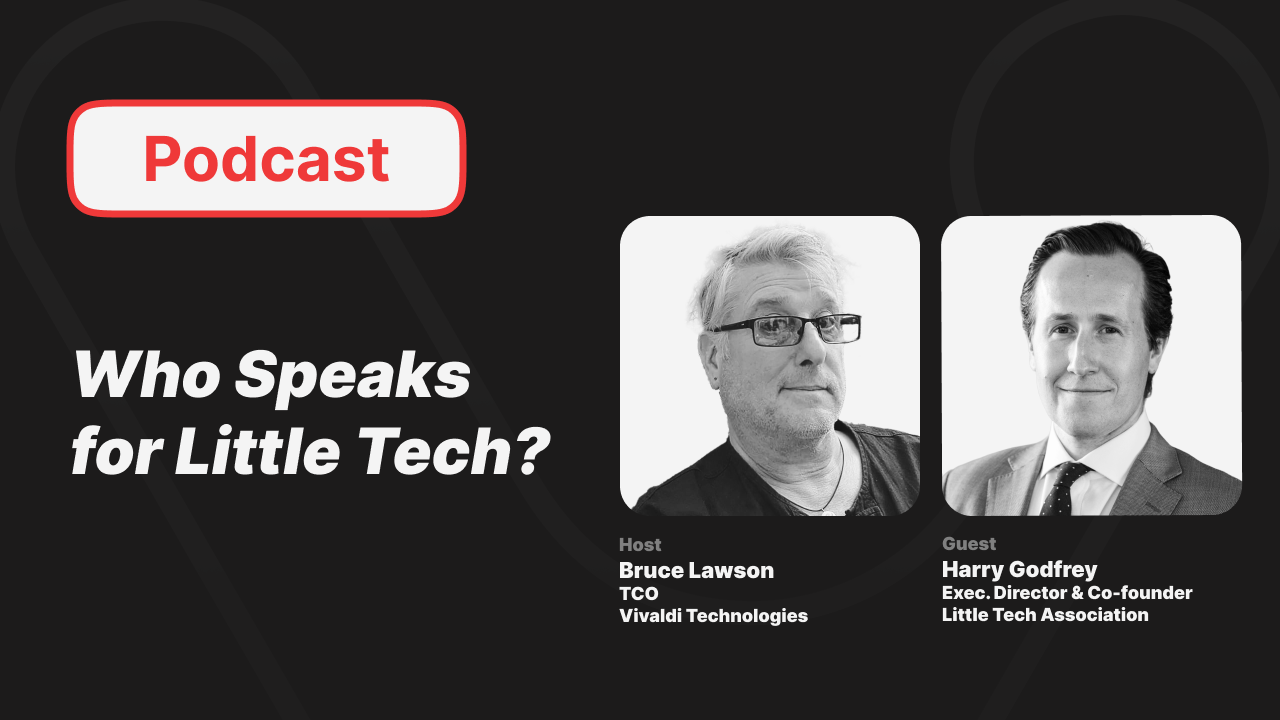
Harry and Bruce talk about who’s actually representing startups in Washington, and who claims to represent them while actually serving Big Tech’s interests. They get into how incumbents use market power to shut out competitors, why Harry sees smart, targeted regulation as the thing that keeps markets open rather than the opposite, and what the antitrust breakups of Microsoft, AT&T and Standard Oil may suggest about the moment tech is in now with AI.
Transcript
[Bruce]: Hello everybody, and welcome to another edition of the For a Better Web podcast, in which I, Bruce Lawson, the technical communications officer at the Vivaldi browser, have a convivial chat with somebody, somewhere, who in their own way, in their own industry, is trying to make the web a better place. And today I’m delighted to introduce Harry Godfrey from the Little Tech Association. Hello, Harry.
[Harry]: Hi Bruce, thanks for having me on.
[Bruce]: Thanks for being here, sir. What is the Little Tech Association?
[Harry]: The Little Tech Association is newly formed. We’re a business association, a business coalition or trade group, formed here in the United States, although with members on both sides of the Atlantic. We’re working hard to make certain that it’s easier within the tech industry for startups, growth stage companies and early stage investors to actually start, build and grow great tech companies, and to see that great products, great services and great applications succeed on their merit, not market power.
[Bruce]: Okay, so a trade group-cum-lobbyists. Would that be legitimate, or is “lobbyist” a dirty word?
[Harry]: Lobbyist is sometimes a dirty word. I would call us advocates. Advocates for the perspective of our member companies. We have over 240 members that run the gamut in terms of products and services, but broadly care about making certain that they have a competitive, vibrant, dynamic digital economy in the United States and around the world. And increasingly, those two things are intertwined.
[Bruce]: Yeah, for sure. And full disclosure to all our listeners and viewers: Vivaldi is a member of, or allied to, the Little Tech Association.
[Harry]: Indeed, you are members. Thank you for being part of it. And for everybody listening, if you are part of a startup or a growing tech company, please come join us. I’m certain that Bruce will put a link in the show notes so you can come visit us and find out all about it.
[Bruce]: Got you. So, as I asked you, I think, when we first met, when we were talking about Vivaldi joining: isn’t Washington DC already full of lobby groups for little tech?
[Harry]: They’re full of groups for tech, but little tech is a different story. To think about the ecosystem of advocates and organizations representing technology, you have to break it down into three buckets.
You’ve got your big, longstanding trade associations that are comprised of a really wide variety of technology companies, but their boards and their governing structure are made up of representatives of the largest tech companies out there. Be it the Magnificent Five, Magnificent Seven, depending on how you’re looking at it. They largely hew to the priorities of those companies and organizations. I’m not criticizing them for that. That’s exactly how they operate, it makes sense, and they’re pretty darn transparent about it.
Then there’s a small but growing set of organizations like ours that actually seek to represent little tech in various segments, maybe middle tech in some cases. Those are allies. They are small but mighty in number.
But there’s a third set of organizations which muddies the picture, and it’s really important to understand. There are organizations that claim to represent startups, but if you look into their staffing, if you actually explore their financing, what you’ll discover is that more often than not, they are supported by the largest companies in this business. And that’s problematic, because there are times when the interests of startups and early stage competitors and big dominant incumbents are at odds. I’m sure we’re going to get into this even more, but in a nutshell, this is a competitive ecosystem, and we have seen for decades the largest incumbents try to lock up markets, close out rivals, and stifle and stymie competitors. So if you have an organization that, for all intents and purposes, is run by big tech but claims to represent little tech, there’s a fundamental conflict of interest there.
And so yes, there are places that will raise their hand and say, we would be happy to have your startup come and be part of our organization. But if you want them to pursue smart competition policy, interoperability reforms, the sort of policies that build an open web, they are either curiously silent or take a position that would be at odds with startups. So we looked at that and we said, there’s a gap here. There is a need for an organization that is genuinely financed, founded and supported by little tech, that represents them legitimately. And that’s where LTA fits in.
[Bruce]: Okay, so I won’t ask you to be completely indiscreet and name any of these groups that claim to represent little tech, but you can if you want to. But why? Big tech can have its own lobbying groups. Why would it be funding a group that claims to represent little tech but actually isn’t? What’s the motivation for that?
[Harry]: My cynical Washington interpretation is that it’s about muddying the waters. So that when policymakers or other advocates say, here’s a good policy that would actually help grow competition, that would actually help support small businesses, there’s an organization that ostensibly looks like it represents small businesses on the other side saying, no, it won’t. And policymakers, moving fast and trying to take in a lot of information, have a hard time discerning between the legitimate representatives and, shall we say, the front groups, or what we would refer to in Washington as astroturf. That’s the purpose: to muddy the conversation and complicate the picture, when really it should be pretty simple.
[Bruce]: I think so. Define “little” and define “tech”. You said 240 members. What is little? What kind of tech is involved? Is it, say, photocopying machines? Is that tech or not? What’s included and what isn’t?
[Harry]: It’s a broad definition. We welcome a wide variety of companies serving almost every sector, both software and hard tech. You’ve got companies in the B2B SaaS market, you’ve got companies helping the legal profession modernize and accelerate the integration of AI, you’ve got a raft of AI-native companies, and we’ve got some early stage neolabs in there as well. Any sector you look across where tech is disrupting or accelerating change and business development, you’re probably going to find an LTA member company.
Once you get up to a certain market size, where your market cap starts looking like middle tech, or certainly approaches the size and scale of big tech, then you’re probably not little tech anymore. But given the sheer magnitude of the biggest tech companies, we’re talking about multi-trillion dollar companies, we have a lot of headroom to admit companies that under any other circumstance people would say are not little. Given the nature of market valuations, the capability for companies to scale rapidly, and the size of the addressable market, what is little to us may seem medium to even large.
[Bruce]: So it can comprise the gamut, from small startups to what many people would think of as medium size, like Vivaldi, which has close on 60 full-time members of staff, going up to what many people in your world would think of as mid-size, assuming multi-million dollar turnover, from all sectors. What unites those groups? What are the commonalities that LTA is fighting for, or indeed fighting against?
[Harry]: There’s no one thing that necessarily unites every member of the Little Tech Association. At the broadest level, it’s a desire to see markets where they can compete openly and fairly and win on their merits rather than on market power. The dynamics around each of those markets, or subsidiary markets, are different.
Take Vivaldi, or the set of search engine companies and browsers that are out there. For an organization like that, the competitive activities that existing monopolies, namely Google, have placed in the way of discovering other search engines and using them effectively become uniting interests. The self-preferencing activities, the foreclosure that occurs there. You can take that sort of behavior and apply it to other markets within the tech ecosystem and say, that looks similar to this, to this, to this.
But then we might look at a company that’s trying to move into the B2B SaaS or CRM space, trying to disrupt what maybe Salesforce or LinkedIn does. And there it might be a question around data portability and access to otherwise proprietary information. It’s a real question of who owns that data and who gets to use it. I don’t think that’s wholly dissimilar to the self-preferencing behavior that we see from monopolists that shut out search engines, but it is a separate and distinct element.
We’ve also got hard tech folks who are thinking about how to sell to established markets, but also how to sell to the government. We have a number of companies in the broad defense and security infrastructure space, and they’re thinking about the contracting structure that has essentially locked in the existing defense primes and contractors. How do I disrupt that? What underlying policy change needs to occur so that there’s more competition, more access, more ability to bid and win contracts? At the highest level, that looks similar as a competition dynamic, but in terms of practical policy implications, the process by which we solve for it is different.
[Bruce]: Interestingly, you’re saying dynamic markets, disrupting monopolists, self-preferencing, and so on. So I would posit that it would be incorrect to see the Little Tech Association as a group of hippies sitting around singing “Kumbaya”. This is very much a capitalist organization, wishing to make capitalism more… more capitalist, if that’s not a weird phrase.
[Harry]: Yeah, no. To paraphrase a notable British Prime Minister, we believe that capitalism is the worst form of economic organization, except for all the others. We believe in creating free markets. We just know that free markets require robust enforcement and smart, carefully tailored regulatory interventions in order to make certain that they continue to be free. And that goes to our underlying principle of empowering consumers to make their own choices. That’s where we get into the open web, data portability, interoperability. Not only is there the ability on the part of the disruptors to enter a market, but there’s the ability on the other side of that market, on the part of the consumers, to pick the services and the companies they want, rather than being handcuffed to existing incumbents, stuck in those walled gardens. And then empowering those builders more broadly to make certain they have access to whether it is the competitive solicitations, or the capital, or the resources they need in order to compete and succeed.
My fundamental metric of success for the Little Tech Association is whether, at the end of the day, our advocacy and the policy and regulatory change we put in place expands the total addressable market for our members or not. So no, we are not a bunch of hippies sitting around singing “Kumbaya” and wishing for a better day of world peace. We are all about making certain that companies start, grow and compete in the tech space. It is capitalist to its core.
[Bruce]: I’m going to come back to that, but you mentioned you’re not wishing for world peace, and you mentioned that there are defense organizations in Little Tech. Who is not allowed in?
[Harry]: We have to think about that carefully. In thinking about who best fits and who might not be as good a fit for little tech, it comes down in no small part to whether we’re able to, as I say, keep the main thing the main thing. If we become an organization that is advocating for politics where the center of gravity within the organization becomes the interest of a very specific subset of our membership, whoever that may be, because there is significant appetite there but also significant controversy around it, that may serve that subset of members well, but it does not serve the entirety of our membership as a whole. It draws resources and attention away from our central mission, which is making certain that we do really effective policy advocacy, expanding the total addressable market for little tech.
So take organizations involved in mass surveillance, for instance. There’s a great deal of controversy, certainly on this side of the pond, in regard to Flock cameras. Without taking a political stance on the merits of mass surveillance, if that were a member company of ours, or if we were seeking to make certain that there was more access to that, it would take us away from actually serving little tech broadly. So we very intentionally think about that, and we think about it for a number of sectors where there’s particular attention. That doesn’t mean that on the edges, folks who are doing a little bit of this or a little bit of that can’t be part of it.
The other thing I would say is that we have to think about ourselves as a business association, both as an advocacy organization and as a business. There are existing associations and groups that represent very specifically that slice of the tech industry. Take, for instance, betting and prediction markets. There is a whole set of trade associations, as well as a whole set of very well-financed companies, that are very specifically focused on that. If we did that, that would be the only thing we did. That’s not the core mission, and focusing on it takes away from that. So you can probably think of a half dozen industry sectors where, if you were in that sector, that really comes to define the entirety of you, and we want to make certain that no one of those things does. That does not mean that on a case by case basis we don’t look at these companies and say, is there enough alignment with what you are doing to work with us or to fit into our membership? In those edge cases, we have to make a careful and deliberate decision on membership.
But beyond that, the vast majority of the tech space… those are organizations and sectors that take up a lot of room, draw a lot of attention, generate a lot of light and a lot of heat, but they’re not actually representative of the vast majority of founders and builders out there. A lot of these folks are trying to do a lot of things that generally fly below the radar. And yet policymaking around those sectors will decide whether or not they succeed or fail. That’s what we want: to build an organization essentially for everybody else, so that they feel like they are well represented.
[Bruce]: Got it. That’s clear from the answers about the sectors, but I also want to reassure our listeners that Vivaldi hadn’t got into bed with people who do crypto stuff, or Flock and their ilk. You said “we would have to decide.” Who is “we”, Harry? Who decided? Who set this up?
[Harry]: We have a founding quartet of members, a really great set, and I think in some ways they’re really representative of the industry. In no particular order: Yelp, a longtime champion for competition, obviously very focused on local search and advocacy for the search markets in general, and deeply engaged in highlighting and combating the monopolistic practices, particularly of Google, on both sides of the Atlantic.
Replit, a great representative: a relatively young but fast-growing company, an exemplar of what AI is doing to change the tech ecosystem. If anybody is not already familiar with them, they’re a vibe coding company, similar to Lovable for instance, that is helping other companies and small businesses and businesses of all sizes build out their tech capabilities, giving people the ability to build software, websites and applications without a programming background. But they are also, and we can go into this further, if not a cautionary tale, certainly an example of how the continued gatekeeper dynamic within the tech ecosystem can impair or inhibit innovation around AI and its applications.
Then Y Combinator, really an iconic brand, one of the longest standing, if not the longest standing, and certainly most notable early stage incubators and investors. They’re really important for us because they think through how companies go from zero to the first $100 million in revenue or market capitalization. That’s an area that we are thinking about very closely. How do we make certain that folks are able to start and able to grow?
And then Proton, the privacy and security focused email and productivity suite. They’re trying to build the privacy-first, consumer-first alternative to Gmail and G Suite, and I think they’re an exemplar of how companies can do something different from a surveillance-centric, data-harvesting approach to these issues. So that’s our founding quartet. They help comprise the board, which we are still building out as well, and they help us set our priorities and our goals within the organization.
[Bruce]: Gotcha. I’ve heard of most of those, and Proton in particular. We’ve had Andy Yen and the Proton head of security on the podcast before, so they’re certainly well known to Vivaldi users. I want to go back, if I may, to the quasi-political point, or actually a philosophical point, that you made: we need advocacy in order to free the market to do what the market’s supposed to do. And that resonates with me here in the United Kingdom, because our regulatory authority, the Competition and Markets Authority, was recently… it’s not recently set up, but our previous prime minister gave it a steer to be light touch, and there’s been more and more noise since we changed administration that regulation isn’t anti-growth, it’s actually pro-growth, similar to what you’re saying the LTA’s position is, over here. Am I mischaracterizing it, or is that…
[Harry]: No, I don’t think so. I would advocate for balance. It’s really important. There is a point, maybe earlier than you and I might see, where regulatory burden becomes something that really does inhibit startup growth in the early stage. If you just say, here are all the compliance documents, here are the things that you need to fill out, and you build that with Salesforce or Microsoft or Google in mind, then their teams of lawyers, their outside counsel, will readily be able to figure out and comply with those things. And the startup that’s trying to do the same thing but has to meet the same obligations will just be buried under that. So there is absolutely a risk of regulatory overburden. And this is a very live debate in Washington right now, where regulation can actually create regulatory capture, not just in the sense of the incumbents coming in and managing the regulators, but where the regulatory system essentially locks out challengers. And so it further embeds and entrenches incumbents. That is absolutely something we need to guard against.
That being said, the other extreme is also really dangerous. I believe in free markets, and I know free markets and economics well enough to know that the pure, platonic free market rarely exists without some degree of intervention on the part of the state, in no small part to essentially serve as cops on the beat. Because people can come into the market, they can gain a degree of market power, and then they can abuse that market power to bring more business to themselves. It becomes a vicious cycle where they grow larger and use that size and scale to further eclipse and shut out rivals, and then they just feed themselves. At some point they become this monopolistic Goliath that not only other businesses but even the state has difficulty contending with.
So where I do think regulation can be particularly helpful, and is particularly needed in the case of tech, where scaling and that vicious cycle can happen so quickly, is to look at those anticompetitive behaviors and say, wait a minute. You purported to be a platform that allowed everybody to build the open web, to find what they wanted, to find the best products, but you’re actually abusing that power. You’re using it towards your own ends. And the problem with that is that your ends may not always be the best product or the best service for the consumer, but you’re not giving them a real choice. So there needs to be somebody who says, hang on a second, that’s not how this should work. Let’s pull the reins on that for a minute and make certain that you are not abusing the power you have.
So we’re not opposed to companies growing, scaling, being large in nature. We are deeply skeptical, though, when you have a large, particularly multi trillion dollar incumbent, about the possibility for its behavior serving to foreclose the market. We always want to make certain that we have free markets. Like we were talking about before, we’re capitalist to our core. We believe that markets are probably the best way of identifying the best products and really driving innovation. I think this is the other important part. There’s the static view: hey, let’s have an open marketplace so consumers can see all the products and pick the best one. That’s great, and it’s beneficial in and of itself to the consumer. But then we need to take a longer view, which is: if you have that market, and people are always searching for the best product, and people are competing for market share and believe they can actually win that market share by having a slightly better product, then that genuine competition becomes a spur for real and continuous innovation. In the absence of that, there is not that same incentive. In the absence of real competition, and without cops on the beat and really smart regulation, what we see all too often is a slowdown and a stifling of innovation, which is something we really need to avoid. So fundamentally, and sorry for coming all the way back around to your beginning point, we do see merit in smart, carefully tailored regulation that keeps markets open, drives competition and thereby drives innovation.
[Bruce]: I’m aware that I’m taking up a load of your time, Harry, so let’s wind it back closer to home. Who are you and where are you from? You seem to be incredibly knowledgeable about the tech world. Have you been a tech worker all your life? Have you been a tech policy man? What’s your background?
[Harry]: That’s very kind of you to say, Bruce, but no, I have not. I have an undergrad in economics and a graduate degree in public policy with a focus on science, technology and environmental policy. I actually spent the past decade working in the clean tech space, which makes me something of an unusual candidate to serve as executive director of LTA. But I actually think the skill set that I developed, particularly in the past eight years at another trade association working on clean tech, is readily transferable in a couple of different ways.
The prior association I was at was called Advanced Energy United. It was actually a pan-clean tech trade association, so we really had the gamut of technology providers in there. The challenge for us, unlike an organization that said, we’re just representing the solar industry, or we’re just representing folks building and deploying electric vehicles, is that we had to find the common uniting linkages between seemingly very disparate organizations. How could we build good public policy and advocacy campaigns that actually served these organizations in a united manner, served them well, and grew their total addressable market, in the same way that we’re doing here? Being able to find the commonalities and help people come together and say, yep, we see the common cause, we’re going to fight towards this, is a readily transferable skill set and is very much what we’re working to do here at LTA.
The other thing I found readily transferable here is that there was very much a dynamic of existing entrenched incumbents. In the energy space, they were entrenched through regulatory structure, i.e. the opposition was your existing state utilities. What the clean tech companies were trying to do was enter markets that were specifically regulated, which created a moat for the utilities. So how did you break through that? How did you change policy so that it actually opened those markets? How did you further open the aperture? What attracted me to that fight, amongst other elements, was the David versus Goliath part of it. I believe deeply in free markets. I really don’t like to see incumbents distort those markets or capture those markets, because I believe at my core in the ability of free markets to both deliver the maximum good for consumers and drive innovation. We get better as a society as we drive technology forward, and that doesn’t happen if a comfortable and well-intentioned incumbent says, nope, I can take all the consumer welfare, and I don’t have to worry about bringing out a slightly better application or building the next phase of hard tech, because there’s no threat to me. I’ve got a product everybody has to buy, and nobody else can challenge me for this. That is the antithesis of what I want to see in society.
And given how deeply tech infuses all of our lives, and the dynamics of this particular moment, we’re in this unique moment of dynamism because of AI, and Replit is an iconic example of this. There’s a real ability for builders, for folks sitting in a dorm room or a garage somewhere, to build something great that disrupts whole segments of the marketplace. Can they bring that to market? Can consumers find that? Can it scale? Can they challenge the incumbents? This is the vibe. I was actually just out in the Bay Area last week talking with founders of early stage companies, many of whom are our members. And the vibe is like that of the early web 20, 25 years ago, where people looked around and went, oh my goodness, the internet is here, everybody is able to get on it now, and we can actually build new, exciting and innovative things. Some people are looking at it to get rich, some people are just going to do cool things, and everybody will be able to discover it.
And the story of the past two-plus decades has not been one of continuous openness. Bruce, you have been fighting this for longer than I have. It has been a story of increasing foreclosure, of a movement from an open web to a series of walled gardens, where the walls get higher and the gardens get decidedly less and less attractive once you’re trapped in them. I don’t want this next era of AI innovation to feel the same way. In this moment of dynamism, where there’s so much opportunity to create so many new things and really accelerate the pace of innovation, there’s also equal, if not greater, danger in just the opposite happening: those tools being captured by existing incumbents, and the competition issues that we still haven’t solved from the last era actually raising the walls of the garden higher and, to borrow a Cory Doctorow term, enshittifying it. I want to avoid that.
[Bruce]: I hear you. You mentioned now’s a time of dynamism when people in dorm rooms or in a garage can make a business. Apple and Google started in garages, but they didn’t really have incumbents to challenge, because…
[Harry]: I would challenge that a little bit. If you don’t have the US versus Microsoft antitrust proceedings of the late ’90s and early aughts, maybe you don’t have… I mean, Apple’s technology story precedes that, but then also comes back after that. I don’t think you have a Google unless you have US versus Microsoft come along and say, you are trying to monopolize web services and this can’t stand.
[Bruce]: Oddly enough, we had Gene Burrus, who used to be Chief Counsel for Microsoft immediately after Microsoft versus DOJ, and he made the point that you wouldn’t have an Apple if it hadn’t been for that.
[Harry]: So that story, if we look back at economic history more broadly, we see repeated time and again. The ultimate decision to break up AT&T and create this diversified set of Baby Bells really led to the proliferation of cellular communication technology in the ’80s and early ’90s, because suddenly you’ve unlocked Bell Labs, which was a place where some really good innovation was going on, but it was being kept within the walls of this incumbent, because, well, we’re the phone service, who else is going to come and challenge us? I guess occasionally we’ll be nice by dribbling out a little something extra. Ooh, look, we’ll give everybody caller ID. I remember the days when I was like, wow, you can see who’s calling you on the phone. Now, if I try to explain that to my own children, the idea that that is a unique and novel service, being able to see who’s calling you on the phone, they would look at me like I’m crazy. But in the absence of competition, there’s not a driving spur for an innovator to bring that product out. A monopolist doesn’t want to do that. So we see that breakup, and I think that really leads to the cellular revolution that dramatically changes our society. But you can go all the way back 100-plus years and think about the breakup of Standard Oil and the amount of economic growth and innovation that comes out of that. The story repeats itself. We know what happens when monopolists are challenged: markets are opened, and more innovation and more growth result.
[Bruce]: Really? Standard Oil, of course, means… yeah, from the energy sector to little tech. I suppose we all have our Standard Oil to fight against, and the candidate for today’s Standard Oil depends very much on which particular day of the week it is, so we won’t go there. I’ve taken up enough of your time, Harry. One last question I want to ask you: when we were making the promo for this, Bendik had done a LinkedIn search and found that your name is Harrison. So who’s your favourite Harrison: George Harrison from the Beatles, or Harrison Ford?
[Harry]: Oh, I mean, as an American, I think I have to go with Indiana Jones and Han Solo. But let’s be clear, that is by no stretch of the imagination denigrating George Harrison, both his career with the Beatles and his solo career, which is really incredible. And in case anybody doesn’t know, he was also a real contributor and financier for Monty Python’s Life of Brian. We don’t have all of that great comedy if not for George Harrison. So I’m sorry, you’re presenting me with a Sophie’s choice here. I’m really beyond expressing my American love of all that Harrison Ford has done in his repertoire. I’m not going to choose.
[Bruce]: My silly throwaway question proved to be the hardest one of the whole conversation. Harry, thank you so much for coming on. I look forward to working with you and meeting you next week in London, where I will show you what proper beer tastes like. It may be revelatory to you as an American, or maybe you’re used to it. Thanks so much for coming on the show. Listeners and viewers, I will put all the links in the show notes. If you’re running a little tech organization somewhere in the US or further afield, you could probably talk to Harry, and he’ll do you a deal, because he’s a great believer in open markets. Harry, thank you so much.
[Harry]: Thank you, Bruce.
[Bruce]: Listeners, thank you for listening. See you next time on For a Better Web.
Shownotes
- Little Tech Association
- Andy Yen (Proton head) on FABW
- Patricia Egger (Proton security) on FABW
- Gene Burrus on FABW
- US vs Microsoft
- US vs Apple
- How George Harrison – and a very naughty boy – saved British cinema